

Two of the most popular cosmetic dental procedures — dental implants and veneers — often get mentioned in the same conversation, but they do very different things. If you’re weighing your options, understanding the key differences between dental implants and veneers is the first step toward making a decision that’s right for your smile, your budget, and your long-term dental health.
This guide walks you through everything you need to know: what each procedure does, the benefits of each, the drawbacks, how costs compare, and most importantly — how to figure out which one fits your unique dental needs.
What Are Dental Veneers?
Dental veneers are thin shells made of porcelain or composite resin that are bonded directly to the front surface of existing teeth. Veneers are thin, precisely crafted, and designed to change the appearance of teeth that are present and structurally intact — they don’t replace anything.
Veneers are primarily used to address cosmetic concerns: discoloration that doesn’t respond to whitening, chips, cracks, slight misalignment, uneven spacing, or teeth that are misshapen. Veneers can cover a surprisingly wide range of imperfections, and porcelain veneers in particular are known for a natural, translucent appearance that closely mimics the look of real enamel.
How the Veneer Process Works
Getting dental veneers typically takes two dental visits.
During the first appointment, your dentist prepares the teeth by removing a thin layer of enamel — usually less than a millimeter — to ensure the veneer fits flush with the surrounding teeth. Impressions are taken and sent to a dental lab where your custom veneers are made. Temporary veneers protect the prepared teeth in the meantime.
At the second visit, veneers are applied: the dentist checks the fit and color, then permanently bonds each veneer to the tooth surface with a strong dental adhesive. A curing light sets the bond. The process is generally straightforward and requires minimal recovery time.
Benefits of Veneers
- Transform your smile quickly. Veneers can cover staining, chips, gaps, and uneven shapes in just two appointments — one of the fastest cosmetic dental upgrades available.
- Natural-looking results. Porcelain veneers are designed to reflect light the way natural tooth enamel does. Most people cannot tell the difference.
- Veneers can improve multiple issues at once. A single veneer can address discoloration, shape, and minor alignment at the same time.
- Veneers require minimal preparation. Compared to implants, the procedure is non-surgical and far less involved.
- Veneers are generally more affordable than dental implants, making them accessible to a wider range of patients seeking cosmetic improvements.
- Veneers are less invasive. No surgery, no implant placement, no extended healing period.
Drawbacks of Veneers
- Veneers require removal of enamel, which is permanent. Once enamel is removed, the teeth will always need to be covered by veneers or another restoration.
- Veneers may need to be replaced. Veneers typically last 10 to 20 years. Veneers can last longer with proper care, but they will eventually need replacement.
- Veneers are not a solution for missing teeth. Veneers are applied to existing teeth — they cannot replace a tooth that has been lost.
- Veneers may be more susceptible to chipping if you grind your teeth or bite hard objects.
- Not typically covered by dental insurance, as they are primarily a cosmetic dental procedure.
- Veneers are bonded to the tooth surface and cannot be removed without replacement.
What Are Dental Implants?
Dental implants are a long-term solution for replacing missing teeth. A dental implant is a titanium post that is surgically placed into the jawbone, where it acts as an artificial tooth root. After osseointegration — the process by which the titanium fuses with the bone — an abutment is attached to the post, and a crown is placed on top to complete the restoration.
Dental implants replace the entire tooth structure, from root to crown. They are designed to function, look, and feel like natural teeth, and when properly placed and maintained, dental implants can last a lifetime.
Implants replace missing teeth — they do not improve the appearance of existing ones. If you have a gap from a lost tooth, an implant fills that space permanently and prevents the bone loss and shifting that follow tooth loss. Implants also help preserve the jawbone, something no other tooth replacement option can fully replicate.
How the Dental Implant Process Works
The dental implant process takes place over several months and involves multiple stages.
Consultation and planning: Your dentist or oral surgeon reviews your bone density and overall dental health to determine whether you’re a good candidate for dental implants. X-rays and 3D imaging are typically used.
Implant surgery: The titanium implant is surgically placed into the jawbone under local anesthesia or sedation. This is an outpatient dental procedure.
Osseointegration: The implant integrates with the jawbone over a period of three to six months. This biological bonding process is what gives dental implants their stability and durability.
Abutment placement: Once the implant has fully integrated, an abutment — a small connector — is attached to the top of the implant post.
Crown placement: A custom dental crown is secured to the abutment, completing the restoration. The crown is matched to the color and shape of surrounding teeth.
Aftercare and maintenance: Getting dental implants requires diligent oral hygiene and regular dental visits, just like natural teeth.
Pros of Dental Implants
- Dental implants replace missing teeth permanently. Unlike dentures or bridges, implants are anchored in the jaw and do not shift or slip.
- Dental implants look and feel like natural teeth. Most patients report that implants function identically to their original teeth.
- Implants can last a lifetime. Dental implants can last 20 to 30 years or longer — and in many cases, a lifetime — with proper care.
- Implants also help preserve the jawbone. When a tooth is lost, the jawbone in that area begins to deteriorate. Dental implants are the only tooth replacement option that stimulates the bone the way a natural root does.
- Implants provide a stable foundation for chewing, speaking, and smiling without any concerns about movement.
- Implants are designed to be permanent and are not removed for cleaning like dentures.
- Implants replace the entire tooth — root and crown — making them the most complete tooth replacement available.
Cons of Dental Implants
- Dental implants are typically more expensive than veneers or other tooth replacement options. The cost of dental implants includes surgery, osseointegration time, the abutment, and the crown.
- The process takes time. From implant placement to final crown, getting dental implants takes several months due to the healing and osseointegration process.
- Implants involve surgery, which carries standard surgical risks including infection and, rarely, implant failure.
- Not everyone is a candidate for dental implants. Sufficient bone density is required. Patients with certain health conditions or significant bone loss may require bone grafting first.
- Dental implants are often not covered by dental insurance or are only partially covered, depending on the plan.
- Recovery from implant surgery requires some downtime and post-surgical care.
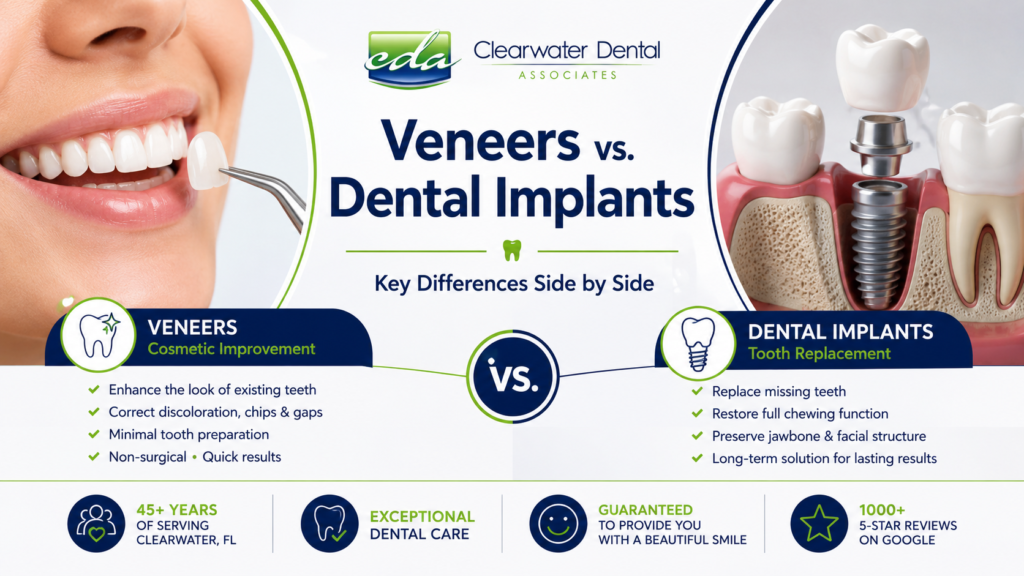
Veneers vs. Dental Implants: Key Differences Side by Side
Veneers improve the appearance of existing teeth, while dental implants replace missing teeth. They are not competing treatments — they solve different dental problems.
Dental Veneers
Best for improving the look of teeth that are already present and structurally healthy.
Dental Implants
Best for replacing missing teeth and restoring long-term chewing function.
Veneers vs. Dental Implants: Key Differences Side by Side
Understanding the differences between dental implants and veneers comes down to one fundamental distinction: veneers improve the appearance of existing teeth; implants replace missing ones. They are not competing solutions to the same problem — they solve different problems entirely.
| Feature | Dental Veneers | Dental Implants |
|---|---|---|
| Purpose | Cosmetic improvement of existing teeth | Replacement of missing teeth |
| Procedure type | Non-surgical | Surgical |
| Treatment time | 2–3 weeks | 3–9 months |
| Longevity | 10–20 years | 20+ years to lifetime |
| Cost | Lower upfront cost | Higher upfront cost |
| Bone preservation | No | Yes |
| Enamel removal required | Yes (minimal) | No |
| Restores chewing function | No (cosmetic only) | Yes (full function) |
| Insurance coverage | Rarely | Partial in some cases |
| Invasiveness | Minimal | Moderate to significant |
Cost of Veneers vs. Cost of Dental Implants
Cost is often the deciding factor for patients exploring their options. Veneers are generally more affordable upfront — porcelain veneers typically range from $900 to $2,500 per tooth depending on the material and complexity. Composite veneers are less expensive but may not last as long.
The cost of dental implants is higher per tooth — typically ranging from $3,000 to $5,000 or more for a single implant, including the post, abutment, and crown. When bone grafting is needed, costs increase further.
However, longevity must factor into any cost comparison. Veneers may need replacement every 10 to 15 years. Dental implants are a long-term solution that can last decades without replacement. When assessed over a patient’s lifetime, implants can actually be the more cost-effective option for replacing a missing tooth — particularly when the alternative is a denture or bridge that also requires eventual replacement.
Neither procedure is typically covered by dental insurance when performed for purely cosmetic reasons, though implants may receive partial coverage when the tooth loss is due to injury or disease.
Longevity: How Long Does Each Last?
Veneers typically last 10 to 20 years with proper care. Veneers can last longer when patients avoid habits like grinding, biting nails, or chewing ice. When a veneer chips or wears down, it must be replaced.
Dental implants can last a lifetime. The titanium post integrates permanently with the jawbone and does not degrade. The crown placed on top may need replacement after 15 to 20 years, but the implant itself — the root-replacement component — typically lasts as long as the patient does. Implants are designed to be a permanent solution, which sets them apart from virtually every other tooth replacement option.
Differences Between Dental Implants and Veneers: Which Is Right for You?
Choosing between dental implants or veneers starts with a simple diagnostic question: Do you have a missing tooth, or do you have a tooth that’s present but looks the way you’d like to improve?
Choose Veneers If:
- Your teeth are present and structurally healthy but you want to change their appearance
- You’re dealing with discoloration, chips, minor misalignment, or gaps between teeth
- You want a faster cosmetic transformation
- You’re a candidate for dental veneers — meaning your teeth have enough enamel for bonding and your bite is reasonably stable
- Budget is a consideration and you’re looking for cosmetic improvement without surgery
Choose Dental Implants If:
- You have one or more missing teeth
- You want a replacement that functions exactly like a natural tooth
- You want to preserve your jawbone and prevent bone deterioration
- You’re looking for a permanent, long-term solution
- You’re a healthy adult with sufficient bone density, or willing to pursue bone grafting if needed
It’s also worth noting that dental implants and veneers are not mutually exclusive. Some patients get implants to replace missing teeth and veneers to improve the appearance of the remaining natural teeth, achieving a comprehensive smile transformation that addresses both function and aesthetics.
Can You Get Veneers If You Have Dental Implants?
Yes — veneers and dental implants can coexist. However, veneers cannot be placed on implant crowns because the surface material is different. If you’re planning both treatments, the sequence typically involves placing implants first and allowing them to fully integrate before fabricating veneers, so that the final veneer shade can be matched to the completed restoration.
It’s important to discuss your full treatment plan with your dentist before beginning any procedures so that the final aesthetic result is cohesive and planned from the start.
What About Crowns, Bridges, and Dentures?
Veneers vs. implants aren’t the only comparison worth understanding. Here’s how other common restorations fit into the picture:
Dental crowns cover the entire visible portion of a tooth — unlike veneers, which only cover the front surface. Crowns are used when a tooth is damaged, cracked, or has undergone root canal treatment. A crown is also placed on top of a dental implant post as the final visible restoration.
Dental bridges replace missing teeth by anchoring to the adjacent natural teeth, which must be filed down to support the bridge. Unlike implants, bridges do not address bone loss beneath the missing tooth.
Dentures are removable replacements for multiple missing teeth. Unlike dental implants, dentures do not stimulate the jawbone and require daily removal for cleaning. Implant-supported dentures offer a more stable, permanent alternative that combines implant anchoring with full-arch restoration.
Making the Right Decision for Your Dental Health
The best way to decide between dental implants or veneers — or to determine whether another type of dental restoration is more appropriate — is a consultation with an experienced cosmetic dentist who can evaluate your specific dental needs, bone health, budget, and aesthetic goals.
There is no universal answer. The right choice depends on your dental concerns, what you’re trying to achieve, and the state of your existing teeth and jaw. What works for one patient may not be ideal for another.
At Clearwater Dental Associates, we provide both dental implants and veneers as part of our comprehensive cosmetic dentistry and restorative dentistry services. Whether you’re exploring dental implants to restore a missing tooth or porcelain veneers for a complete smile transformation, our team will walk you through every option so you can make informed decisions about your smile.
Contact us today to schedule a consultation and find out which treatment is the right fit for your unique dental needs.
Frequently Asked Questions: Dental Implants vs. Veneers
Q: Are veneers the same as implants?
No. Veneers are thin shells bonded to the surface of existing teeth for cosmetic improvement. Dental implants are titanium posts surgically placed in the jaw to replace missing teeth. They solve completely different problems.
Q: Can veneers replace a missing tooth?
No. Veneers can only be applied to teeth that are already present. Implants replace missing teeth. If you have a gap, an implant (or bridge or denture) is the appropriate treatment.
Q: Which lasts longer — implants or veneers?
Dental implants last significantly longer. The implant post can last a lifetime; the crown on top may eventually need replacement after 15 to 20 years. Veneers typically last 10 to 20 years before needing replacement.
Q: Are dental implants worth the cost compared to veneers?
For replacing a missing tooth, dental implants are generally considered the gold standard — they preserve bone, restore full function, and last far longer than alternative replacements. For cosmetic improvement of existing teeth, veneers are often a more practical and affordable solution. The “worth” depends entirely on what problem you’re trying to solve.
Q: Does dental insurance cover veneers or implants?
Dental insurance rarely covers veneers because they are primarily cosmetic. Implants may receive partial coverage when tooth loss resulted from an accident or medical condition, depending on the policy. Financing options are available for both treatments at many dental practices.
Q: What is the difference between a crown and a veneer?
A dental crown covers the entire visible tooth structure and is used to restore a damaged, decayed, or root canal-treated tooth. A veneer covers only the front-facing surface of a tooth and is used primarily for cosmetic purposes on otherwise healthy teeth.
Q: Can I get both implants and veneers? Yes. Many patients combine both treatments — implants to replace missing teeth and veneers to improve the cosmetic appearance of existing teeth — for a complete smile makeover that addresses both function and aesthetics.