

Cracked Teeth Repair in Clearwater, FL
A cracked tooth rarely announces itself cleanly. Sometimes you feel a sharp pain when you bite down, then nothing. Other times the tooth aches constantly or reacts badly to hot and cold. Whatever you’re experiencing, it’s worth getting an evaluation before a minor crack becomes a major problem.
At Clearwater Dental Associates, our team has been treating cracked and broken teeth for patients throughout Clearwater and Pinellas County for more than 45 years. We examine the tooth, explain what we find, and go over your treatment options so you can make an informed decision about your dental care. The phone number to call us is (727) 797-8800.
Signs You May Have a Cracked Tooth
Cracked teeth don't always cause obvious symptoms, which is part of what makes them tricky to self-diagnose. Some patients come in with visible tooth damage; others have no idea anything is wrong until a routine exam turns something up.
That said, a few patterns tend to show up repeatedly:
Pain when you bite down, especially when releasing pressure after chewing
Sensitivity to hot drinks, cold drinks, or sweet foods
Intermittent pain that's hard to pin down to a specific tooth
A crack or chip you can feel with your tongue
Swelling or tenderness around the gum line near one tooth
Discomfort that keeps returning even after the original cause seems to have resolved
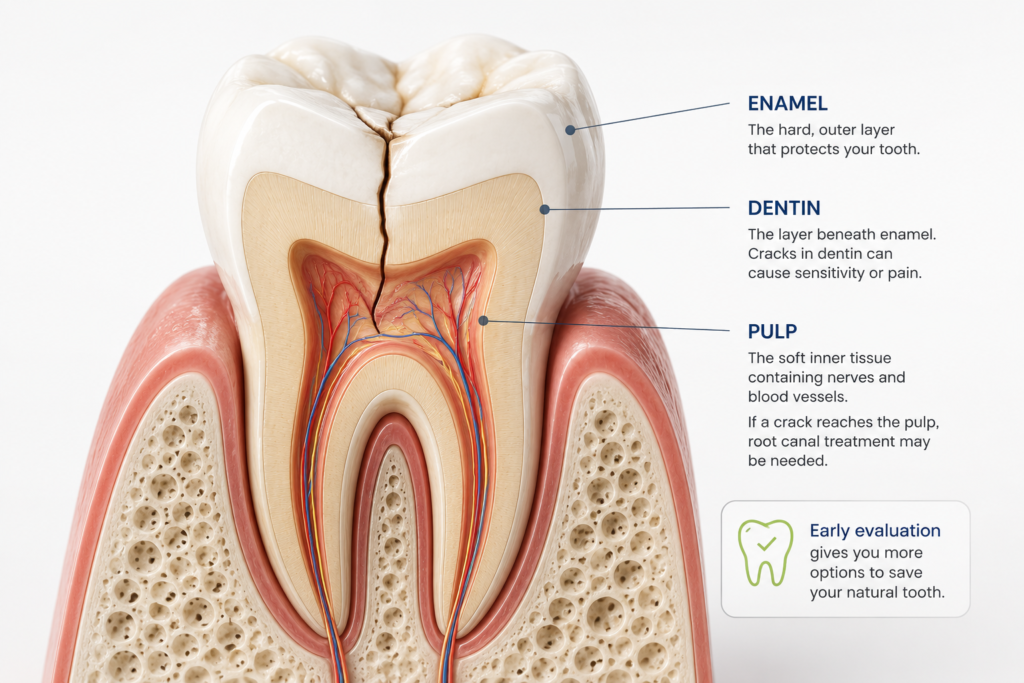
Symptoms vary a lot depending on the location of the crack, how deep it goes, and whether the dental pulp — the soft tissue at the core of the tooth — is involved. That's why a clinical exam matters more than a self-diagnosis.
Types of Cracks
in Teeth
Tooth fractures fall into several distinct categories, and the type of crack largely determines what treatment — if any — is needed.
Craze Lines
These are superficial cracks in the enamel — the outer layer of the tooth. Craze lines are extremely common, often painless, and in most cases don't require any treatment beyond monitoring. They affect the surface only and don't extend into the deeper tooth structure.
Fractured Cusp
When a piece of the tooth's chewing surface breaks off, that's a fractured cusp. It often happens around a large filling or area of existing tooth damage. These fractures are usually restorable and rarely involve the pulp.
Cracked Tooth
This is the classic presentation — a crack that runs from the chewing surface down toward the root. How far it extends determines how complex treatment becomes. Cracks that reach the pulp typically require root canal treatment before any restoration can be placed.
Split Tooth
A split tooth means the crack has progressed to the point where the tooth has separated into distinct segments. In most cases, a split tooth can't be saved intact, though depending on the position of the split, part of the tooth may be salvageable.
Vertical Root Fracture
A vertical root fracture originates at the root and extends upward. These are particularly difficult to detect and often cause minimal symptoms until a dental infection develops. They typically carry a poor prognosis and may require extraction.
Can a Cracked Tooth Be Repaired?
Often, yes — but it depends on the tooth. The key factors are the depth of the crack, its location, whether the pulp is involved, and how much healthy tooth structure remains. A cracked tooth that’s caught early generally has more treatment options than one that has been ignored for months.
What our dentists at Clearwater Dental Associates can tell you with confidence is this: early evaluation gives you more choices. Waiting until pain becomes severe or infection sets in can lead to tooth loss that could have been avoided with timely care.
Repairing a cracked tooth
Options for
Cracked Tooth
Repair
Treatment depends on what the dentist finds during the evaluation. Here's a general overview of the most common approaches.
Dental Bonding
or Filling
For minor cracks or small chips that haven't reached the deeper layers of the tooth, dental bonding using tooth-colored resin may be appropriate. A filling may also be used when a crack has affected a cavity-prone area of the tooth. These are generally conservative treatment options suited to superficial or early-stage damage.
Dental Crown
A crown is one of the most common treatments for a cracked or fractured tooth. It's a cap placed over the tooth to protect the remaining structure and restore its shape and function. Crowns are typically recommended when a tooth has a significant crack, when a large filling has weakened the surrounding enamel, or when the tooth has suffered a fractured cusp. Our restorative dentistry team at CDA will evaluate whether a crown is the right fit and what material makes the most sense for your particular tooth.
Root Canal
Treatment
If the crack has extended into the pulp — the nerve-containing tissue inside the tooth — root canal therapy is usually necessary before any restoration can be completed. Root canal treatment removes the affected pulp, cleans the canals, and seals the tooth so it can ultimately be restored with a crown. It's worth noting that most teeth treated with root canals can still function normally for years with proper care.
Tooth Extraction
When a crack extends below the gum line, the tooth has split in half, or a vertical root fracture has made the tooth unrestorable, tooth extraction may be the recommended course. Extraction is never the first choice, but it is sometimes the right one — particularly when leaving the tooth in place could lead to infection or affect surrounding teeth. If a tooth does need to come out, we can discuss tooth replacement options including dental implants as a next step.
Getting the diagnosis right
How We Evaluate
a Cracked Tooth
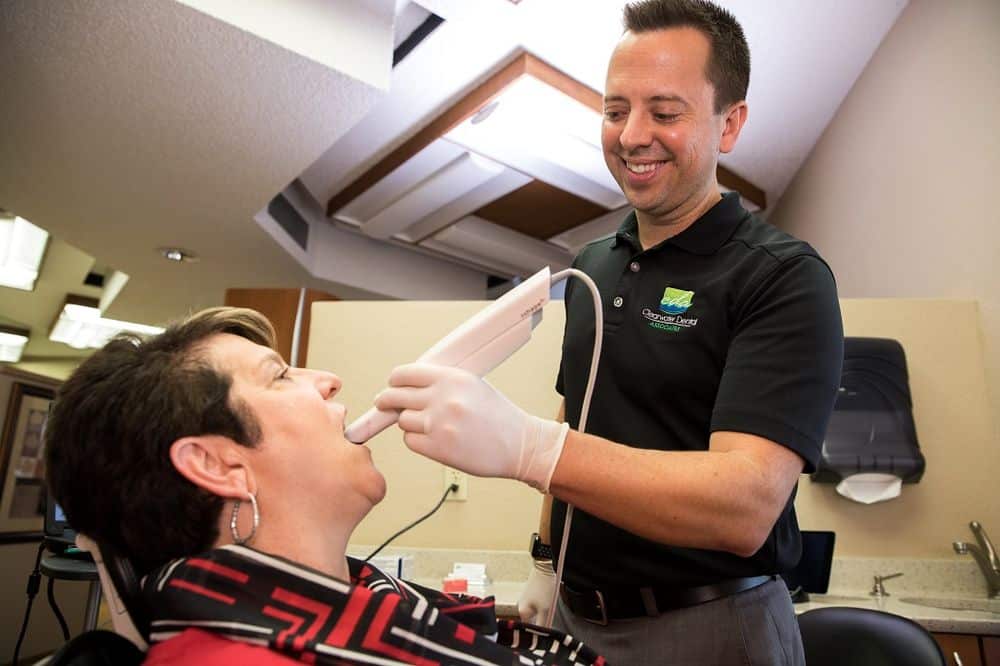
Diagnosing a cracked tooth accurately takes more than a visual inspection. Our team uses several approaches to understand what's happening:
- Symptom review — we'll ask when the pain occurs, what makes it better or worse, and how long you've been noticing the problem.
- Clinical examination — checking the tooth, surrounding gum tissue, and bite under good lighting.
- Bite testing — we may have you bite on a small device that helps isolate which tooth and which area of the tooth is affected.
- Digital X-rays — while not all cracks are visible on X-rays, our digital imaging helps us assess the roots, surrounding bone, and any structural changes. Advanced imaging may also be used when additional information is needed.
Based on what we find, we'll explain the condition of the tooth in plain language and lay out the realistic treatment options — including what happens if the tooth is left untreated.
Careful
Evaluation.
More Treatment
Options.
Know when it needs urgent attention
Is a Cracked Tooth
a Dental Emergency?
Not every cracked tooth is an emergency, but some definitely are. You should seek emergency dental care promptly if you experience any of the following warning signs.
Severe or Escalating
Tooth Pain
Pain that becomes intense, persistent, or noticeably worse can indicate that a crack has reached deeper structures inside the tooth.
Seek Prompt CareSignificant Swelling
Swelling in the gum, jaw, or face can be a sign that inflammation or infection is developing around the damaged tooth.
Don't Ignore Swelling
Visible Trauma or
a Broken Tooth
Visible injury to the tooth or jaw should be evaluated, particularly if a large piece of the tooth has broken away.
Dental Trauma
Pain Preventing
Normal Chewing
If pain makes it difficult or impossible to bite or chew normally, the tooth may be unstable or the crack may involve a deeper portion of the tooth.
Needs Evaluation
Signs of
Infection
A pimple-like bump on the gum, an unpleasant or bad taste in the mouth, fever, or increasing swelling may indicate that bacteria have reached the inner tooth or surrounding tissues.
Urgent Warning Sign
What If Symptoms
Are Mild?
Mild or intermittent symptoms still deserve an evaluation. Minor cracks can progress, and a tooth that's painless today may develop more serious problems if it goes unchecked.
Schedule an Evaluation
Trusted dental care in Clearwater since 1978
Why Choose
Clearwater Dental
Associates?
Clearwater Dental Associates has been providing dental care in Clearwater, FL since 1978. Our team of five experienced dentists — Dr. Nolan Allen, Dr. Matthew Burton, Dr. William Spencer, Dr. Maria Hernandez, and Dr. Keith Kiskaddon — collectively covers a wide range of restorative and general dental treatment, which matters when a cracked tooth turns out to need more than one type of care.
We use digital X-rays and a 3D Cone Beam Scanner to get a detailed picture of what's happening inside and around a damaged tooth. For patients who are anxious about dental treatment, our sedation dentistry options make it easier to get the care you need without dread getting in the way. We also offer same-day consultations for urgent concerns.
Decades of local dental care and established experience in the Clearwater community.
Digital X-rays and 3D Cone Beam imaging help us understand what's happening beneath the surface.
Sedation options and same-day consultations help make getting timely care easier.
Call us and let us know what's going on.
What to Expect at Your Appointment
We keep the process straightforward:
Evaluation
We review your symptoms and examine the tooth, gum tissue, and surrounding teeth.
Diagnosis
Using bite testing, clinical examination, and imaging where appropriate, we identify the type and extent of the damage.
Treatment Discussion
We explain the findings and walk through your options — including what the tooth needs, what each treatment involves, and what happens if you choose to wait.
Treatment
When you're ready to move forward, we proceed with the recommended dental treatment — whether that's bonding, a filling, a crown, root canal therapy, or another approach based on what the tooth needs.
You'll understand what we found and your treatment options before deciding how you want to move forward.
Common Questions
Frequently Asked Questions About Cracked Teeth
Can a cracked tooth heal on its own?
No. Tooth enamel doesn't regenerate, and cracks in teeth do not close or repair themselves over time. A crack that seems painless today can deepen with continued chewing pressure, potentially requiring more extensive treatment later. Early evaluation is the best way to understand what you're dealing with.
Does a cracked tooth always need a crown?
Not always. Minor cracks or small chips may be addressed with dental bonding or a filling. However, when a crack has weakened a significant portion of the tooth's structure or extended toward the pulp, a crown is typically the most reliable way to protect the tooth and restore its function.
Will I need a root canal for a cracked tooth?
Only if the crack has reached the pulp — the soft inner tissue that contains the tooth's nerves and blood supply. Not every cracked tooth involves pulp damage. A thorough exam helps determine whether root canal therapy is necessary before a restoration can be placed.
What happens if I leave a cracked tooth untreated?
A cracked tooth that goes untreated can worsen over time. Continued pressure on the tooth during normal chewing can cause the crack to propagate deeper. If it reaches the pulp, infection becomes a real risk. In severe cases, a tooth that could have been saved with early treatment may eventually require extraction. Symptoms don't always appear right away — which is exactly why evaluation matters.
My tooth cracked but doesn't hurt — is that normal?
Yes, it's more common than most people expect. Some cracks — particularly craze lines and minor fractures — cause no immediate pain. A painless cracked tooth isn't necessarily a safe one. It still warrants evaluation to understand the type of crack and whether it's likely to become a problem.
Can a cracked molar be repaired?
Often, yes. Cracked molars are among the most commonly treated tooth fractures because molars bear the greatest chewing load and are prone to cracking under pressure, especially when they contain large fillings or have been weakened by bruxism — teeth grinding. Treatment depends on how far the crack extends and whether the pulp or root is involved.
Cracked tooth care in Clearwater
Have a Cracked Tooth?
Get It Evaluated in Clearwater
Cracked teeth are treatable — but the earlier you act, the more options you have. Waiting for symptoms to worsen before seeking care can turn a manageable problem into a bigger one.
Our team at Clearwater Dental Associates will examine the tooth, explain exactly what we find, and help you decide on the right next step. No pressure, no guesswork. Just a clear picture of what's happening and what your options are.
Clearwater Dental Associates
2226 Druid Rd E
Clearwater, FL 33764
Monday–Thursday: 7am–5pm
Friday: 8am–1pm
Same-day consultations are available for urgent concerns.