

Root canals have a reputation problem. For decades, the words alone have been enough to make people tense up in the dental chair — or avoid making an appointment altogether. But the truth about root canal therapy is very different from what most people believe, and those misconceptions about root canals are causing real harm by keeping patients away from treatment that could save their teeth, protect their health, and eliminate actual pain.
This post is here to debunk common myths about root canal therapy, one by one, so you can make informed decisions about your dental health based on fact — not fear. Here are the nine myths and misconceptions about root canals we hear most often, and the real story behind each one.
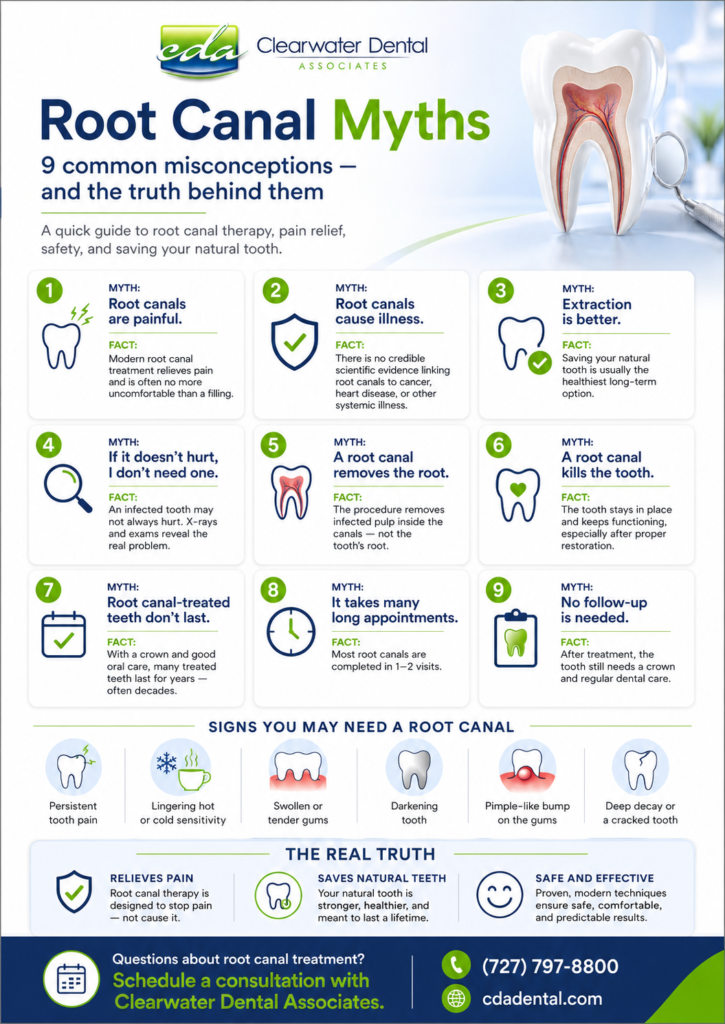
1: Root Canals Are Painful — The Most Common Root Canal Myth of All
Let’s start with the biggest root canal myth: that root canals are excruciating.
The reality? Root canal treatment doesn’t cause pain — it relieves it.
This misconception likely started nearly a century ago, when dental technology was far more limited. Anesthesia techniques were primitive, and the procedure was genuinely uncomfortable. Today, root canals are performed under local anesthesia, and most patients report the experience is no more uncomfortable than getting a filling.
The American Association of Endodontists has found that patients who have actually had root canals are far more likely to describe the experience as painless than those who haven’t had one but fear it. The tooth pain that sends people to the dentist — the deep, throbbing ache of an infected tooth — is what hurts. The root canal procedure is what makes it stop. Root canals relieve pain. That is their purpose.
Modern endodontics uses advanced local anesthesia and precision instruments to keep you comfortable throughout. If you experience dental anxiety, sedation dentistry options are available to make the experience even easier.
2: Root Canals Cause Illness — A Dangerous Misconception with No Scientific Basis
This is perhaps the most harmful myth still circulating on the internet. The claim is that root canal-treated teeth harbor bacteria that spread through the body and cause serious illness — including cancer, heart disease, and arthritis.
This myth started with Dr. Weston A. Price, whose research, conducted nearly a century ago, suggested that bacteria in root canal-treated teeth could leak into the bloodstream and cause systemic disease. There is no credible scientific evidence linking root canal treatment to any illness of this kind.
What actually happened: poorly designed research built on a theory that has been thoroughly discredited by modern science. The American Association of Endodontists is unequivocal on this point. Scientific evidence linking root canal-treated teeth to systemic disease simply does not exist. Evidence linking root canal treatment to cancer, heart disease, or arthritis has been reviewed repeatedly by independent researchers, and the conclusion is always the same — the procedure is safe and effective.
What we do know is that leaving infected teeth untreated is the genuine health risk. An infected root canal left untreated can spread bacteria to surrounding tissue, cause bone loss, and introduce infection into the bloodstream. Root canal therapy removes that infected tissue and seals the tooth. It is the treatment that protects your overall health, not a threat to it.
3: Tooth Extraction Is Better Than Getting a Root Canal
Another common myth about root canals is that tooth extraction is a simpler, cheaper, or more practical alternative. It is none of these things when the goal is long-term dental health.
Your natural teeth are irreplaceable in function. Saving your natural teeth through root canal therapy preserves your bite, your jawbone structure, and the proper alignment of surrounding teeth. When a natural tooth is removed and not replaced, bone loss begins in the area — sometimes within months. Adjacent teeth begin to drift. Chewing becomes progressively more difficult.
Tooth extraction does not end the story — it begins a more complicated and expensive one. Replacing a missing tooth with a dental implant or bridge costs significantly more than root canal therapy and a crown, and those replacements, while excellent options, will never fully replicate the natural function and feel of your own tooth.
Root canal therapy preserves the tooth. Extraction eliminates it. When keeping your natural teeth and protecting long-term oral health is the goal, root canal treatment is almost always the right choice. Learn more about our restorative options if tooth loss has already occurred — but when root canal therapy is still an option, saving the tooth is the priority.
4: If My Tooth Doesn’t Hurt, I Don’t Need a Root Canal
This is a genuinely dangerous myth. Tooth pain is not always present when a tooth needs a root canal, and waiting for pain to guide treatment decisions is a risky strategy that often leads to more serious dental problems.
A tooth that becomes infected can, at a certain stage, stop producing noticeable tooth pain. The nerve inside the tooth may have died, or the infection may have progressed and temporarily drained, easing the acute pressure. The absence of pain does not mean the absence of infection.
Your dentist or endodontist uses X-rays, pulp testing, and clinical examination to determine whether you need a root canal — not pain alone. An infected tooth left untreated continues to damage surrounding bone and tissue, potentially spreading to adjacent teeth and becoming a far more serious dental and medical problem.
Regular dental visits are how these issues get caught before they become emergencies. Routine preventive care is how dental problems are identified early, before pain ever signals there’s something wrong.
5: Root Canal Treatment Removes the Root of the Tooth
This factual myth about root canals causes a lot of unnecessary confusion. The root canal procedure does not remove the root of the tooth. It removes the infected or damaged pulp tissue from inside the root canals — the root stays exactly where it is.
Here is what actually happens: inside every tooth is a soft tissue chamber called the pulp, which contains nerves and blood vessels. When that pulp becomes infected or inflamed — from deep tooth decay, a crack, or repeated dental trauma — your dentist or endodontist accesses the inside of the tooth, removes the damaged tissue, cleans and disinfects the canal space, then finishes with filling and sealing the canals. The root and the structural tooth remain firmly in place.
The tooth is typically restored with a crown after the procedure. It continues to function as a normal tooth, anchored in the jawbone, because it still is a natural tooth. The root canal refers to the inner canals of the root — not the root itself.
6: Root Canals Kill the Tooth
A related misconception is that a root canal “kills” the tooth, leaving behind a dead structure that will fail quickly. This framing is misleading.
Yes, the pulp — the living tissue inside the tooth — is removed during root canal therapy. But removing the pulp does not kill the tooth in any functional sense. The tooth remains anchored in the jawbone, supported by the periodontal ligament, and fully capable of biting and chewing for years. What changes is that the tooth no longer has a blood supply running through it, which means it can become more brittle over time. This is exactly why a crown is placed after root canal treatment — it reinforces the tooth’s structure and extends its lifespan.
Root canal therapy preserves a functioning, natural tooth. That is not a dead tooth — it is a saved one.
7: Root Canal-Treated Teeth Don’t Last Long
Patients sometimes ask whether root canal therapy is worth it because they assume the treated tooth won’t hold up over time. Many root canal-treated teeth last a lifetime when properly restored and maintained — and the evidence strongly supports this.
The two most important variables are the quality of the crown placed after treatment and how well the patient maintains their oral health afterward. A tooth restored with a well-fitted crown and cared for through regular brushing, flossing, and dental visits has every reason to last as long as any other natural tooth.
Saving your natural teeth through endodontic treatment is one of the best long-term investments in your dental health you can make. The alternative — extraction followed by a dental implant or bridge — involves more procedures, higher cost, and a longer recovery timeline. Root canal therapy done correctly is a durable and lasting solution.
8: Root Canals Require Many Long Appointments
Another myth worth addressing is the idea that undergoing a root canal means clearing your schedule for several lengthy visits over multiple weeks. For the majority of cases, root canal therapy is completed in one to two appointments — often in under an hour.
Advanced dental technology has made endodontic treatment faster and more precise than ever. Rotary instruments, digital X-rays, and improved access techniques mean that most straightforward root canals are completed in a single visit. More complex cases — particularly molars with multiple canals or significantly curved roots — may require a second appointment, but this is not the drawn-out ordeal that many patients anticipate.
The root canal procedure is not a marathon. For most patients, it fits comfortably into a regular dental appointment.
9: You Don’t Need to See a Dentist After a Root Canal
This final myth is one that can undo all the work of a successful root canal — the belief that once the procedure is done, there is nothing left to do. In reality, aftercare and follow-up are essential to the success of any root canal treatment.
After root canal therapy, the treated tooth needs to be properly restored — typically with a crown — to protect it from fracture and reinfection. Skipping or delaying this restoration is one of the most common reasons root canal-treated teeth fail. Beyond the crown, the tooth still requires the same daily care as any natural tooth: brushing twice a day, flossing, and regular dental cleanings.
Root canal therapy solves the infection. Proper restoration and ongoing oral health maintenance are what keep the tooth healthy and functional for years to come. Staying connected with your dentist after treatment is not optional — it is part of what makes root canal therapy successful.
Signs You May Actually Need a Root Canal
Now that we’ve addressed the myths and facts around root canal treatment, it helps to know what genuinely signals a problem requiring endodontic care:
- Persistent, severe tooth pain — especially pain that lingers after eating or drinking hot or cold foods
- Spontaneous toothache that appears without any obvious trigger
- Prolonged sensitivity to temperature even after the source is removed
- Darkening or visible discoloration of a tooth
- Swelling or tenderness in the gums near a specific tooth
- A persistent pimple-like bump (called a fistula) on the gums
- Deep tooth decay that has reached the pulp
- A cracked or fractured tooth that has exposed the inner nerve
If you’re experiencing any of these, don’t wait to call your dentist or endodontist. Infected teeth do not heal on their own — they worsen. Left untreated, an infected root canal can spread, cause serious bone damage, and put your overall health at risk. Early treatment is always simpler, less invasive, and more effective than waiting.
The Real Truth About Root Canal Therapy
It’s time to discover the truth behind the fear. The myths and misconceptions about root canals are persistent — but they are not supported by science, and they cost real patients real teeth every year by pushing people toward avoidance or unnecessary extraction instead of treatment.
Root canal therapy is among the most thoroughly studied procedures in dentistry. Common myths about root canals — that they cause illness, that they’re agonizing, that they kill teeth — have all been examined and refuted by modern research. The American Association of Endodontists and dental professionals worldwide agree: root canal treatment is safe, effective, and one of the most reliable ways to preserve a natural tooth.
Root canals relieve pain. They save teeth. They protect your oral health and overall health. The information on root canals that matters most is this: when your dentist recommends one, it is because the evidence supports it as the best path forward for your tooth and your health.
We encourage you to make informed decisions about your dental health based on science, not fear. If you’ve been putting off a root canal, or if you want to understand whether root canal therapy is the right option for your situation, we’re here to help.
Contact Clearwater Dental Associates to schedule a consultation, or explore our general dentistry services to learn more about how we approach comprehensive dental care for patients throughout the Clearwater area.
Frequently Asked Questions About Root Canal Myths and Facts
Q: Do root canals really cause cancer or heart disease?
No. This claim originated from poorly designed research conducted nearly a century ago by Dr. Weston A. Price — research that has been thoroughly discredited by modern science. There is no credible scientific evidence linking root canal treatment to cancer, heart disease, or any other systemic illness. The American Association of Endodontists has addressed this myth extensively.
Q: What does a root canal actually feel like?
Most patients describe undergoing a root canal as similar to getting a filling — minimal discomfort under local anesthesia and a sense of relief afterward as the tooth pain that prompted the visit finally goes away. The procedure itself should not be painful.
Q: How long does a root canal take?
Most root canals are completed in one to two appointments of roughly 60 to 90 minutes each. Straightforward cases are often finished in a single visit. Complex cases involving back molars may require a follow-up.
Q: Is it safe to get a root canal?
Yes, root canal treatment is safe and effective. It is one of the most common and well-studied dental procedures performed worldwide, with a strong long-term success rate.
Q: What happens if I skip the root canal and pull the tooth instead?
Tooth extraction leads to bone loss in the jaw, shifting of adjacent teeth, and the need for a dental implant or bridge to restore function — all of which are more expensive and involved than saving the original tooth. Extraction is sometimes the only option, but saving your natural teeth through root canal therapy is almost always preferable when that option is available.
Q: Can a root canal-treated tooth get infected again?
It can, in rare cases — usually due to a delayed crown placement, a crack in the tooth, or new decay. This is why proper restoration after treatment and maintaining good oral health habits are essential to long-term success.