
- Increasing pain instead of decreasing pain
- Persistent swelling after the first week
- Fever above 101.5°F
- Foul taste or odor from the implant site
- Any looseness in the implant
Special Considerations for Different Types of Implants
Single Tooth Implants
Single-tooth implants are the simplest to maintain because they mimic the care routine for a natural tooth. Focus on the junction between the crown and your gum – that’s where problems typically start.
Multiple Implants and Bridges
You may benefit from using an oral irrigator, also known as a water flosser. Water flossers are especially recommended for patients who have been treated with the All-on-4® dental implant method.
Threading floss under bridges can be challenging, so invest in floss threaders or stick with water flossers for these areas.
Recognizing Warning Signs: When to Call Your Dentist
After 15 years of treating complications, I can tell you the warning signs that patients often ignore:
- Bleeding around implants – especially during brushing
- Persistent bad taste or odor from the implant area
- Any looseness or movement in the crown or implant
- Swelling that doesn’t resolve within a few days
- Changes in your bite or how the implant feels
Early intervention can often save your implants. Don’t wait and hope these symptoms resolve on their own.
The Real Talk About Long-Term Success
Here’s what I wish every patient understood: Dental implants are designed to last for decades, but their success depends on your commitment to oral hygiene.
I have patients who’ve had their implants for 20+ years without a single problem. What do they all have in common?
- They never skip their hygiene routine – morning and night, every single day
- They keep their cleaning appointments – religiously, even when traveling
- They listen to their bodies – and call when something doesn’t feel right
- They’ve made lifestyle changes – especially quitting smoking
Your Action Plan for Implant Success
Starting today, here’s your roadmap:
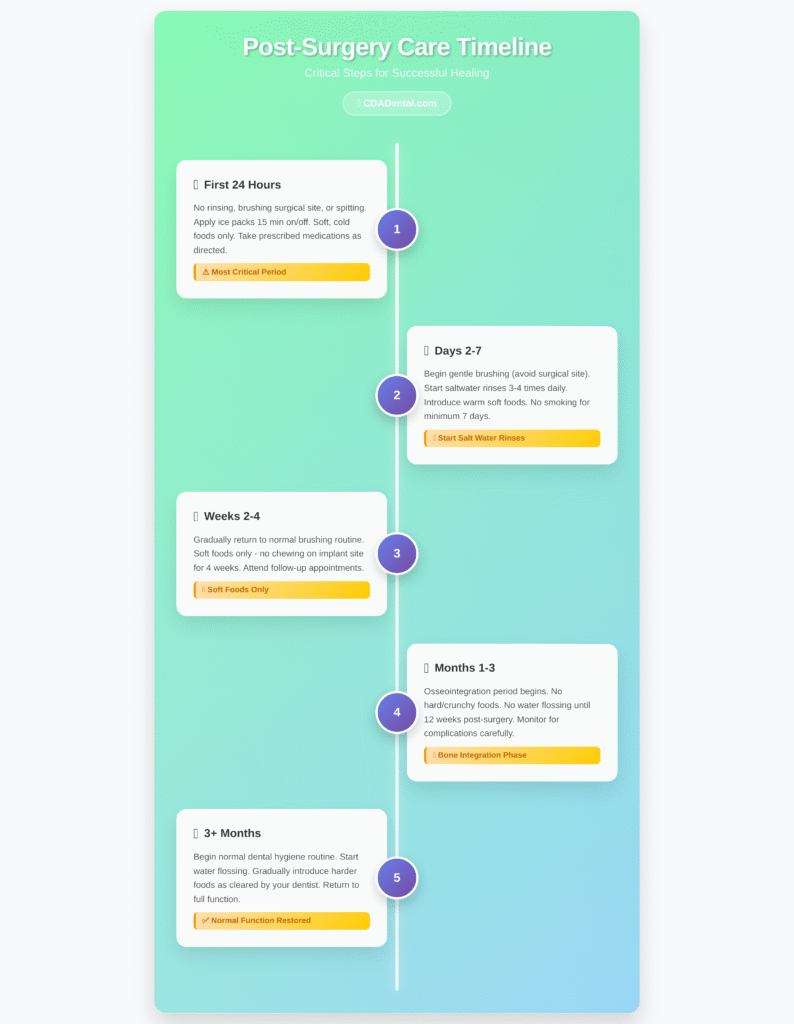
Week 1-2 Post-Surgery:
- Soft foods only (cold first 24 hours, then warm soft foods)
- No smoking, alcohol, or strenuous activity
- Gentle saltwater rinses starting day 2
- Pain medication as prescribed
- No brushing surgical site for first 3 days
Months 1-3 (Healing Period):
- Gradually return to normal foods (avoid hard/crunchy until cleared)
- Start gentle brushing around implant sites after first week
- Continue avoiding smoking completely
- No water flossing until 12 weeks post-surgery
- Regular follow-up appointments for monitoring
Long-term (Lifetime):
- Twice-daily brushing with soft bristles
- Daily flossing or water flossing
- Bi-annual professional cleanings
- Annual x-rays to monitor bone levels
Frequently Asked Questions
Q: Can I use an electric toothbrush on my implants? A: Absolutely! Electric toothbrushes are often better for implant care because they provide consistent, gentle pressure and superior plaque removal.
Q: How long before I can eat normally after implant surgery? A: Most patients can gradually return to normal foods after 4-6 weeks, but avoid very hard or sticky foods for 3 months while osseointegration occurs.
Q: What if I grind my teeth at night? A: You’ll need a night guard. Grinding can damage implant crowns and affect the integration process. We’ll custom-make one that protects both your natural teeth and implants.
Q: Are dental implants covered by insurance? A: Coverage varies, but many plans now cover at least part of implant treatment. We’ll help you navigate your benefits and explore financing options.
The Bottom Line
Caring for dental implants isn’t complicated, but it requires consistency and commitment. The patients in my practice who’ve had their implants for 15+ years without issues all share one thing: they treat their implants like the valuable investment they are.
Your implants can literally last a lifetime with proper care. The alternative – dealing with failed implants, infections, or replacement procedures – is far more complicated and expensive than preventive care.
Remember: you’ve already made the smart choice by getting implants. Now make the commitment to care for them properly, and you’ll be enjoying your beautiful, functional smile for decades to come.
Ready to ensure your implant success? Schedule your next maintenance appointment today. Your future self will thank you for the investment in proper caring for dental implants – and your smile will show it.
You’ve just invested in dental implants – congratulations! You’re now part of the 3+ million Americans who’ve chosen this life-changing solution. But here’s the thing: getting your implants was just the beginning. What happens next determines whether your investment lasts 20+ years or becomes another cautionary tale.
I’ve been placing and caring for dental implants for over 15 years, and I’ve seen it all. The patients whose implants are still going strong after two decades, and those who needed replacements within five years. The difference? How well they followed the caring for dental implants protocol.
This isn’t just another generic aftercare list. This is your complete roadmap to caring for your dental implants after surgery and beyond – from the critical first 24 hours through decades of maintenance, backed by real clinical experience and the latest research. Let’s dive in.
Why Caring for Dental Implants Matters More Than You Think
Here’s what most people don’t realize: dental implants aren’t “set it and forget it” like many believe. Poor care can lead to complications like peri-implantitis, an inflammatory condition that affects the gums and bone surrounding the implant, potentially causing implant failure.
I tell my patients this analogy: think of your implant like a high-performance sports car. Sure, it’s built to last and perform amazingly – but only if you maintain it properly. Neglect the maintenance, and even the best engineering in the world won’t save you from problems.
The statistics are sobering. In a study called “Smoking and Dental Implants: A Systematic Review and Meta-Analysis”, research was conducted and found that of 35,511 smokers and 114,597 non-smokers, the smokers proposed a 140.2% increased rate of implant failure compared to the non-smokers
But don’t worry – with the right approach, your implants can literally last a lifetime. I have patients from my early years of practice whose implants are still functioning perfectly today.
Immediate Post-Surgery Care: The First 48 Hours After Dental Implants
The first two days after dental implant surgery are absolutely critical. This is when your body begins the healing process that will determine your long-term success. Here’s exactly what you need to do – and avoid – during this crucial window.
The Critical DO’s Immediately After Implant
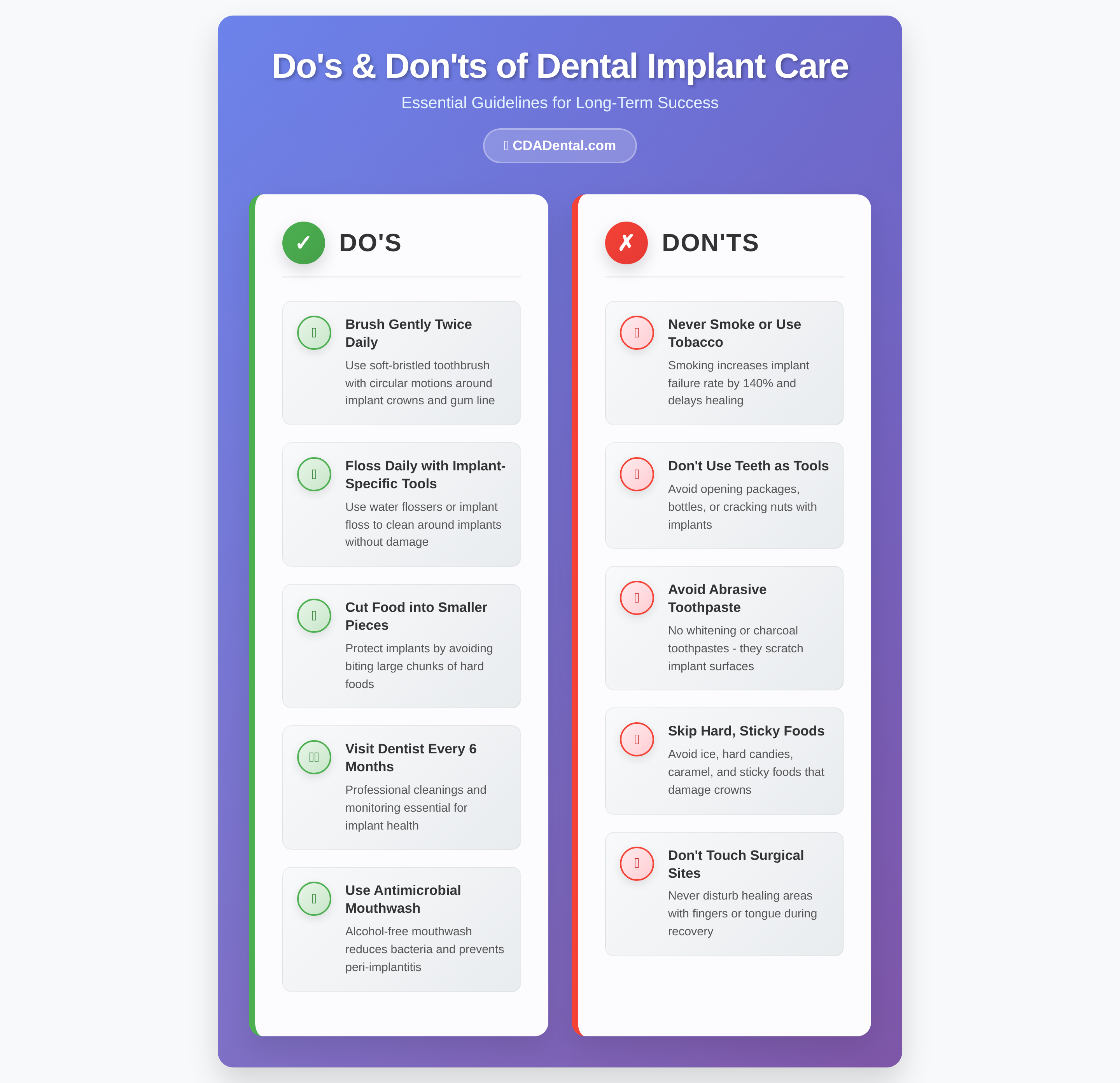
DO: Control Bleeding and Swelling
There is usually minimal bleeding following implant surgery. Slight bleeding, oozing or red tinged saliva is not uncommon. To control bleeding apply continuous pressure for the 30-45 minutes immediately after surgery with the gauze placed by the surgical staff.
For swelling control, apply an ice pack 15 minutes on and 10 minutes off during the first 6-8 hours after surgery. However, the benefits of reducing swelling with ice is limited to the first 24 hours after surgery.
DO: Stick to the Right Foods
You may drink cold liquids and eat cold soft food i.e., Ice cream, jello, pudding, yogurt, applesauce, cottage cheese the day of surgery. Avoid hot liquids and foods for the first 24 hours after surgery resuming warm soft foods the day after i.e.. eggs, oatmeal, pancakes, mashed potatoes, well cooked pasta.
I always tell my patients: “If you can cut it with a fork, it’s probably okay for the first week.”
DO: Take Medications as Prescribed
Take prescribed medications as directed by your doctor. Some discomfort is normal following oral surgery. It is often beneficial to take the medication after eating to help prevent nausea.
DO: Maintain Proper Head Position
For the first 8 to 12 hours post-surgery, avoid moving around excessively and keep your head elevated. Lay in a semi-reclined position. Keep your head above your heart unless you feel faint.
The Absolute DON’Ts in the First 48 Hours
DON’T: Disturb the Surgical Site
Do NOT disturb the wound. Avoid spitting or touching the wound for a few days after surgery. There may be a metal stump slightly protruding through the gum tissue – don’t touch it with your tongue or fingers.
DON’T: Rinse or Brush on Day One
Day 1 (Day of surgery/first 24 hours after surgery): Do not rinse or brush your teeth. Do not spit. Rinsing may dislodge the blood clot and interrupt the normal process of healing.
DON’T: Smoke or Use Straws
Don’t spit or suck through straws immediately following surgery. As with any oral surgery procedure, smoking of any kind, including but not limited to (tobacco, marijuana, vape pens) should be stopped for 7 days after surgery to minimize delayed healing and pain caused by smoking.
The sucking motion can create negative pressure that dislodges blood clots – leading to painful complications like dry socket.
DON’T: Exercise or Do Strenuous Activity
No strenuous physical activity or smoking for 10 days. Your body needs to focus its energy on healing, not recovering from workouts.
Week 1-2 After Dental Implants: Transitioning to Normal Care
What Changes After the First 48 Hours
Day 2 Onwards: Begin Gentle Oral Hygiene
Starting day 2, brush your teeth 2 to 3 times a day. Be careful of the incisions. You may begin brushing your teeth with a soft bristled toothbrush the morning after surgery avoiding the surgical site for the first 3 days.
Introduce Salt Water Rinses
Warm salt water rinses (one teaspoon of salt in 8oz of warm water) should be used 3-4 times daily, for the first week after surgery. This helps keep the area clean without being too aggressive.
Gradual Food Introduction
Refrain from eating crunchy or chewy food for 10-14 days. Do NOT chew on the implant site for 4 weeks. After 4 weeks, you may chew soft foods only.
Special Instructions for Caring for Dental Implants After Surgery
When Stitches Are Involved
If stitches were placed they will resorb in 2-5 days, in certain cases the stitches will not breakdown and will be removed at your follow-up appointment. Don’t try to remove them yourself – let them dissolve naturally or wait for your follow-up appointment.
Prosthetic Considerations
No temporary prosthesis may be placed on the implant site for at least 3 weeks unless advised otherwise. This gives the implant time to begin integrating with your bone without additional pressure.
Water Flosser Timeline
Do not start a Waterpik® until 12 weeks after the surgery. While water flossers are excellent for long-term implant care, they’re too aggressive during the initial healing phase.
Month 1-3: The Osseointegration Period
This is when the magic happens – your implant fuses with your jawbone in a process called osseointegration. Caring for your dental implants during this period is crucial for long-term success.
What’s Happening in Your Mouth
Your jawbone will become the foundation for your dental implants. However, any disruption can weaken this foundation, and your jawbone will not fuse to the implants properly.
During this period, I monitor my patients closely. We’re looking for signs of proper healing and integration. Most importantly, we’re watching for any complications that could jeopardize the implant.
Critical Care During Osseointegration
Avoid Hard Foods Completely
Avoid eating anything hard, crunchy, and/or chewy for the entire duration of healing, which is usually 8 weeks, as determined by your surgeon at the time of surgery. This isn’t negotiable – I’ve seen implants fail because patients got impatient with soft foods.
No Excessive Force
Don’t use your teeth as tools during this period. Even normal chewing should be gentle and mindful. Think of your implant site as fragile – because it is.
Monitor for Complications
Watch for these warning signs during the healing period:
- Increasing pain instead of decreasing pain
- Persistent swelling after the first week
- Fever above 101.5°F
- Foul taste or odor from the implant site
- Any looseness in the implant
Special Considerations for Different Types of Implants
Single Tooth Implants
Single-tooth implants are the simplest to maintain because they mimic the care routine for a natural tooth. Focus on the junction between the crown and your gum – that’s where problems typically start.
Multiple Implants and Bridges
You may benefit from using an oral irrigator, also known as a water flosser. Water flossers are especially recommended for patients who have been treated with the All-on-4® dental implant method.
Threading floss under bridges can be challenging, so invest in floss threaders or stick with water flossers for these areas.
Recognizing Warning Signs: When to Call Your Dentist
After 15 years of treating complications, I can tell you the warning signs that patients often ignore:
- Bleeding around implants – especially during brushing
- Persistent bad taste or odor from the implant area
- Any looseness or movement in the crown or implant
- Swelling that doesn’t resolve within a few days
- Changes in your bite or how the implant feels
Early intervention can often save your implants. Don’t wait and hope these symptoms resolve on their own.
The Real Talk About Long-Term Success
Here’s what I wish every patient understood: Dental implants are designed to last for decades, but their success depends on your commitment to oral hygiene.
I have patients who’ve had their implants for 20+ years without a single problem. What do they all have in common?
- They never skip their hygiene routine – morning and night, every single day
- They keep their cleaning appointments – religiously, even when traveling
- They listen to their bodies – and call when something doesn’t feel right
- They’ve made lifestyle changes – especially quitting smoking
Your Action Plan for Implant Success
Starting today, here’s your roadmap:
Week 1-2 Post-Surgery:
- Soft foods only (cold first 24 hours, then warm soft foods)
- No smoking, alcohol, or strenuous activity
- Gentle saltwater rinses starting day 2
- Pain medication as prescribed
- No brushing surgical site for first 3 days
Months 1-3 (Healing Period):
- Gradually return to normal foods (avoid hard/crunchy until cleared)
- Start gentle brushing around implant sites after first week
- Continue avoiding smoking completely
- No water flossing until 12 weeks post-surgery
- Regular follow-up appointments for monitoring
Long-term (Lifetime):
- Twice-daily brushing with soft bristles
- Daily flossing or water flossing
- Bi-annual professional cleanings
- Annual x-rays to monitor bone levels
Frequently Asked Questions
Q: Can I use an electric toothbrush on my implants? A: Absolutely! Electric toothbrushes are often better for implant care because they provide consistent, gentle pressure and superior plaque removal.
Q: How long before I can eat normally after implant surgery? A: Most patients can gradually return to normal foods after 4-6 weeks, but avoid very hard or sticky foods for 3 months while osseointegration occurs.
Q: What if I grind my teeth at night? A: You’ll need a night guard. Grinding can damage implant crowns and affect the integration process. We’ll custom-make one that protects both your natural teeth and implants.
Q: Are dental implants covered by insurance? A: Coverage varies, but many plans now cover at least part of implant treatment. We’ll help you navigate your benefits and explore financing options.
The Bottom Line
Caring for dental implants isn’t complicated, but it requires consistency and commitment. The patients in my practice who’ve had their implants for 15+ years without issues all share one thing: they treat their implants like the valuable investment they are.
Your implants can literally last a lifetime with proper care. The alternative – dealing with failed implants, infections, or replacement procedures – is far more complicated and expensive than preventive care.
Remember: you’ve already made the smart choice by getting implants. Now make the commitment to care for them properly, and you’ll be enjoying your beautiful, functional smile for decades to come.
Ready to ensure your implant success? Schedule your next maintenance appointment today. Your future self will thank you for the investment in proper caring for dental implants – and your smile will show it.