

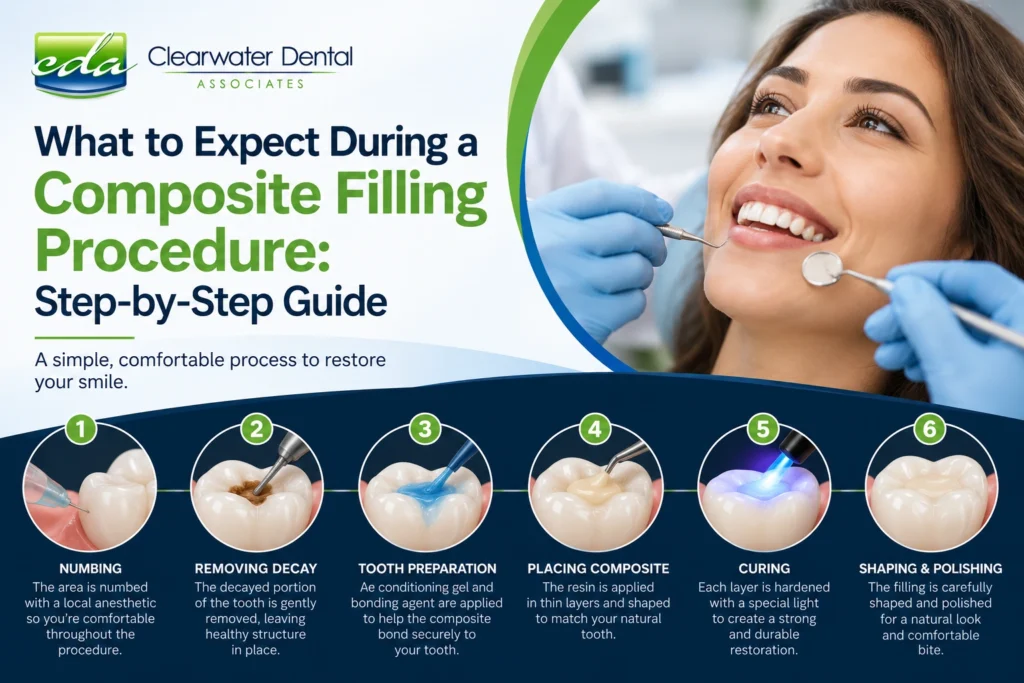
When a dentist recommends a composite filling, most patients have the same reaction: they know roughly what a filling is, but they have no clear picture of what the procedure actually involves. That uncertainty is usually what makes people uneasy, not the procedure itself.
The composite filling procedure is one of the most routine treatments in dentistry. Once the tooth is numb, it shouldn’t hurt. Knowing exactly what’s coming at each stage removes most of the anxiety before you even sit down. This guide walks through the procedure step by step, explains what you’ll feel at each point, and covers what to expect when you get home.
What Is Composite Filling and When Do Dentists Recommend One?
A composite filling is a tooth-colored restoration used to repair a cavity or minor tooth damage. The material, composite resin, is made from a blend of acrylic resin and finely ground glass or quartz particles that can be closely shade-matched to your natural tooth, making the finished result nearly invisible against surrounding teeth.
Unlike traditional amalgam fillings, which rely on the shape of the prepared cavity to stay in place, composite resin bonds directly to the tooth enamel through a chemical adhesive process. This bonding is what allows the dentist to remove only the damaged or decayed portion of the tooth, preserving as much natural tooth structure as possible rather than cutting away healthy enamel to create retention for the filling material.
Your dentist will recommend a composite filling when a cavity is small to moderate in size and enough healthy tooth remains to support the restoration. When decay is more extensive or the tooth has lost significant structure, a different approach may be more appropriate. Our dental crown vs. filling guide explains how that decision gets made and what each option involves. If you want to understand the full range of materials available before your appointment, our dental filling materials explained guide covers the clinical differences between composite, amalgam, ceramic, and glass ionomer restorations.
How Long Does the Composite Filling Procedure Take?
Most composite fillings take between 30 and 60 minutes from start to finish. The time varies based on how large the cavity is, where it’s located in the mouth, and how many surfaces of the tooth are involved. A small single-surface cavity is typically on the shorter end. A larger, deeper restoration on a molar involves more steps and takes longer.
The appointment includes numbing, decay removal, tooth preparation, composite placement in layers, curing, shaping, polishing, and a bite check. All of that happens before you leave the chair.
The Composite Filling Procedure, Step by Step
Here’s exactly what happens during your appointment, and what you’ll experience at each stage.
Step 1: Numbing the Tooth
Before any work begins, your dentist numbs the tooth and surrounding gum tissue using a local anesthetic. You’ll feel a brief sting or pinch when the injection is given near the gum line. That moment is usually the sharpest sensation during the entire appointment.
Within a minute or two, the area will feel heavy and numb. Any pressure or sharp sensation should be gone before the dentist proceeds. If you feel anything more than pressure once work begins, let your dentist know immediately. You should be comfortable throughout the entire procedure, and there’s no reason to push through discomfort during the procedure.
The numbing typically lasts one to three hours after the appointment. The soft tissue in your cheek, lip, or tongue may take longer to recover than the tooth itself. This matters for when you can eat, which is covered below.
Step 2: Removing Decay from the Damaged or Decayed Area
Working from a digital X-ray taken at your exam, your dentist uses a dental handpiece to remove the decayed tissue from the damaged area. You’ll hear the sound of the instrument and feel vibration and pressure. The sensation is more of a buzzing than anything painful.
Pressure is normal. Pain is not.
Because composite resin bonds directly to tooth enamel rather than relying on the cavity shape for retention, your dentist removes only the damaged or decayed material. Healthy surrounding tooth structure stays in place. This conservative preparation is one of the clinical advantages composite has over traditional amalgam fillings, which require additional removal of healthy enamel to create the mechanical retention the material needs.
Step 3: Preparing the Tooth for Bonding
Once the decay is removed, the tooth surface needs to be prepared so the composite resin can adhere properly. Your dentist applies a conditioning gel to the enamel, which microscopically roughens the surface to improve bonding. You may briefly notice its taste. After a short wait, the gel is rinsed off and the tooth is dried carefully.
Next, a bonding agent is applied to the prepared tooth. This liquid adhesive is what allows the composite to chemically bond to the enamel and dentin rather than simply sitting in the space. The bonding agent is cured briefly with a light before composite placement begins.
This bonding step is what makes composite resin adhere so effectively to natural tooth structure. It’s also what makes the restoration conservative, since the adhesive bond means the dentist doesn’t need to create extra cavity shape to hold the filling in place.
Step 4: Placing the Composite Resin in Layers
Before any composite is placed, your dentist selects a shade of composite resin that matches your natural tooth color as closely as possible. The material is then applied in thin incremental layers rather than all at once.
Each layer is shaped carefully to rebuild the tooth’s natural contour. Placing composite in layers, rather than as a single bulk insertion, produces a stronger restoration with less internal stress and shrinkage as the material cures. At this stage, each layer is still soft and moldable.
Step 5: Curing Each Layer with a Curing Light
After each layer of composite is placed and shaped, your dentist hardens it using a curing light, a handheld device that emits a concentrated blue light. You’ll be given eye protection for this step. Each layer takes approximately 20 to 30 seconds under the light to cure fully. You may notice a very faint warmth during curing. This is completely normal and passes immediately.
This is also why composite fillings have simpler post-procedure eating instructions than older traditional amalgam fillings. Amalgam sets through a slow chemical hardening process that takes hours, which is why patients were historically told not to eat on that side for 24 hours. Composite works entirely differently. The curing light hardens the composite resin completely during your appointment. By the time you leave the chair, the filling can restore normal function and is fully solid. The reason to wait before eating has nothing to do with the filling itself.
Step 6: Shaping, Polishing, and Bite Check
Once all layers are cured, your dentist trims and polishes the composite to match the natural contours of your tooth and create a smooth, natural-looking surface. Polishing also reduces the surface texture that can cause staining over time, so it’s not just a cosmetic step.
You’ll then bite down on articulating paper, a thin color-marked paper that shows your dentist exactly where your teeth make contact. This helps identify any spots where the filling is sitting too high above the natural bite line. Getting the bite right is the final and important step in the composite filling procedure.
One important note: this bite check happens while you’re still numb, so your perception of how your bite feels won’t be entirely accurate. Even after the dentist has confirmed the occlusion looks correct on the paper, you may notice something feels slightly different once the anesthetic wears off. More on what to do in that situation below.
After Your Composite Filling: What to Expect
When Can I Eat After a Composite Filling?
You can eat once the numbness has worn off, typically one to three hours after your appointment. The filling itself is completely hardened before you leave the chair. The reason to wait is entirely about the anesthetic. When you can’t fully feel your mouth, biting down on food can cause you to bite your cheek, lip, or tongue without realizing it.
Once the numbness clears, avoid eating on the side of the new filling for the rest of that day. Stick to softer foods while the tooth adjusts. Avoid eating hard or crunchy foods, and for the first 24 hours avoid coffee, tea, and red wine. Composite can pick up surface staining more easily in the immediate period after placement before the surface is fully polished and settled.
Is Sensitivity Normal After a Composite Filling?
Yes, and it’s more common than most patients expect. Some sensitivity to hot, cold, or pressure after a composite filling is a normal response to the procedure. The nerve inside the tooth experiences some degree of irritation from the preparation process, and it needs time to settle. Most sensitivity steadily improves within the first week.
If you’ve had a deeper filling that approached the pulp of the tooth, mild sensitivity that’s gradually decreasing at three to four weeks is still within the expected range. The direction of the trend matters: sensitivity should be getting progressively better, not worse or stable at a high level.
If sensitivity worsens after the first few days, or doesn’t begin improving within the first week, contact your dentist.
What About the Bite Feeling Different?
If your bite feels off after the anesthetic wears off, don’t wait to see if it corrects itself. Composite resin doesn’t wear down on its own the way tooth enamel does over time. A high bite requires a professional adjustment. The good news is that a bite adjustment at CDA Dental is quick, usually comfortable, and often doesn’t require any numbing. Call your dentist rather than enduring an uncomfortable bite for days.
Can I Brush and Floss Normally?
Yes. You can brush and floss normally that same evening. The composite is fully cured and there are no brushing restrictions. Maintaining consistent oral hygiene is one of the most important things you can do for the long-term health of any dental restoration, including composite fillings. Use a non-abrasive toothpaste to preserve the polish on the composite surface over time.
When to Call Your Dentist After a Composite Filling
| What You’re Experiencing | What It Usually Means |
|---|---|
| Mild cold or heat sensitivity, improving over days | Normal — nerve is settling after the procedure |
| Tenderness at the injection site for a day or two | Normal — temporary gum irritation from the anesthetic |
| Sensitivity gradually decreasing at weeks 3-4 (deeper fillings) | Often still within expected range |
| Bite feels slightly different on the day of filling | Can be normal while numbness is still present |
| Bite pain or pressure that doesn’t resolve after 48 hours | Call your dentist — the filling may be sitting too high |
| Sensitivity that worsens after the first week | Call your dentist — not the expected direction |
| Persistent or throbbing pain not improving | Call your dentist — could indicate nerve irritation |
| Swelling in the face or jaw, or fever | Seek care promptly — may indicate infection |
How Does a Composite Filling Compare to Other Restoration Options?
A composite filling is the right choice for most small to moderate cavities in adults, but it isn’t the only option and it isn’t always the most appropriate one. Understanding where composite fits helps you have a more informed conversation with your dentist about whether a composite restoration is appropriate for your specific tooth.
For a detailed comparison of composite against amalgam, ceramic, and other filling materials, our dental filling materials explained guide covers each material’s clinical strengths and limitations. If you’re wondering about durability specifically, our composite fillings strong guide addresses longevity, molar suitability, and how composite holds up compared to amalgam over time.
When a cavity is too large for a filling to reliably restore the tooth, or when significant tooth structure has been lost, your dentist may recommend a crown instead. Our dental crown vs. filling guide walks through how that decision is made. And if you’re interested in understanding the difference between a filling placed directly in the chair versus one fabricated in a lab, our direct vs. indirect fillings guide covers inlays, onlays, and when each approach makes sense.
For information on our composite filling service at CDA Dental, visit our dental fillings page.
Frequently Asked Questions About the Composite Filling Procedure
Does a composite filling hurt?
The procedure itself should not be painful. You’ll feel the injection when the local anesthetic is administered, which is usually the sharpest sensation of the appointment. Once the tooth is numb, you may feel vibration and pressure during decay removal, but not pain. If you feel pain at any point during the procedure, let your dentist know immediately so they can add more anesthetic before continuing.
How long does a composite filling last?
Many composite fillings last ten years or more with proper care. Longevity depends on the size and location of the filling, oral hygiene habits, and how regularly you attend dental checkups. Dental fillings are not permanent and will eventually need replacement. Regular monitoring at checkups allows your dentist to identify when a restoration is showing wear or breakdown before it becomes a larger problem.
Are composite fillings the same as white fillings?
Yes. Composite fillings, white fillings, tooth-colored fillings, and tooth-colored resin restorations all refer to the same material. The terms are used interchangeably.
Can a composite filling be repaired if it chips?
Minor chips can often be repaired by bonding additional composite material to the existing restoration. More significant damage may require replacing the filling entirely. If something doesn’t feel right, schedule an evaluation rather than waiting for the situation to worsen.
Is a composite filling permanent?
No dental filling is permanent, but composite is a durable long-lasting restoration. With consistent oral hygiene and regular dental visits, many composite fillings last a decade or more. Your dentist will monitor them over time and advise you when replacement becomes appropriate.
What if I feel anxious about the procedure?
Dental anxiety is common and you don’t have to manage it alone. If the idea of discomfort during the procedure is what’s holding you back, ask about sedation options at your appointment. CDA Dental offers options to help patients stay comfortable and relaxed throughout their visit.
If you have a cavity that needs attention or want to discuss whether a composite restoration is appropriate for your tooth, contact Clearwater Dental Associates to schedule an evaluation. We place tooth-colored composite fillings in a single visit and will explain your options clearly before any work begins.