

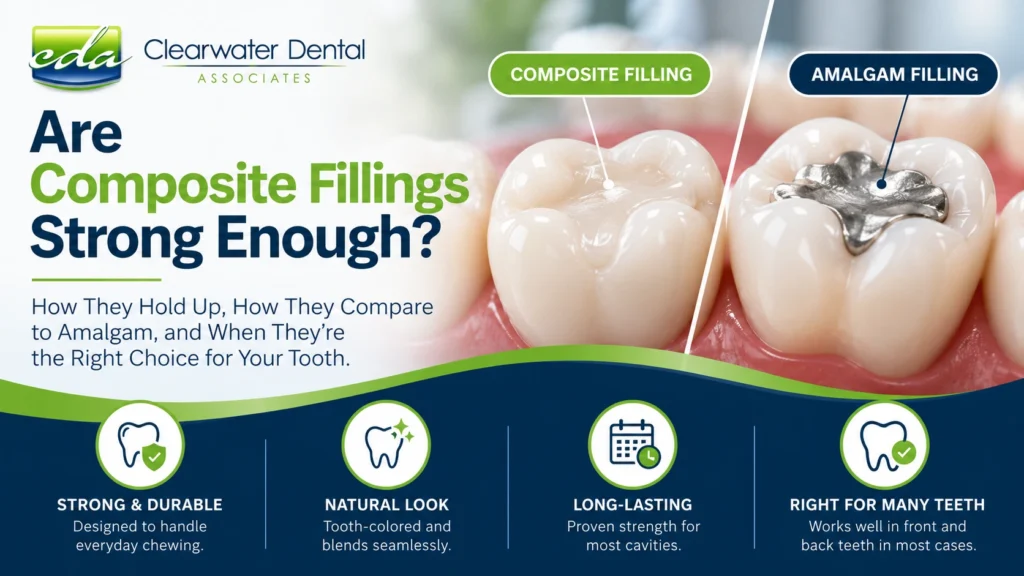
When a dentist at Clearwater Dental Associates recommends a composite filling, the first practical question most patients ask is whether tooth-colored material is actually going to hold up. It’s a fair question, and it deserves a direct answer.
Composite fillings are strong. For the vast majority of cavities in adults, modern composite resin provides the structural strength needed for normal biting and chewing. That said, the complete picture matters. A composite filling in a front tooth faces different demands than one placed in a molar. The size of the cavity makes a difference. So does how you care for your teeth over time. This guide covers what gives composite its strength, how it compares to amalgam, what affects how long it lasts, and how to know when composite is the right choice for your specific tooth.
What Is a Composite Filling and What Is It Made Of?
A composite filling is a tooth-colored restorative material placed in a prepared cavity to rebuild the tooth’s shape and function. The material itself, composite resin, is made from two primary components: a polymer resin base and inorganic filler particles. Those filler particles are typically tiny glass or ceramic particles, and they’re what give composite much of its hardness and resistance to wear during chewing. The resin matrix binds the particles together and allows the material to be shaped and sculpted before it sets.
At Clearwater Dental Associates, composite is placed using a conservative preparation technique. Only the decayed portion of the tooth is removed. The composite bonds directly to the remaining tooth structure using an adhesive system, which means a smaller hole is needed compared to traditional amalgam placement. The result is a tooth-colored filling that restores normal function and is completed in a single visit.
If you want to understand how composite fillings compare to other restoration types, our dental filling materials explained guide covers the full range of available materials and when each is clinically appropriate.
How Strong Are Composite Fillings for Everyday Use?
In practical terms, a properly placed composite filling restores normal tooth function. Your bite, chewing efficiency, and comfort return to normal once the restoration is complete and any brief adjustment period has passed.
Composite resin is designed to withstand the pressures of everyday chewing. The inorganic filler particles within the material help distribute chewing forces across the resin matrix rather than concentrating stress at a single point. For small to medium cavities, this makes composite a clinically sound choice across most tooth positions.
The slight flexibility of composite compared to metal amalgam is not a weakness. A restoration that absorbs and distributes force tends to place less stress on the surrounding tooth structure than a rigid one. For normal daily use, this property works in the patient’s favor.
Are Composite Fillings Strong Enough for Molars?
This is the question patients ask most often, and the answer has changed meaningfully over the past decade.
Older dental guidance cautioned against composite in large, high-stress areas. That legacy left some patients with the impression that composite couldn’t handle back teeth. Current evidence tells a different story. A 2025 systematic review and meta-analysis of clinical trials concluded that light-cured resin composites have become the preferred material for restoring posterior teeth in many dental settings, backed by stronger material formulations, improved adhesive systems, and the clinical advantage of conservative tooth preparation.
Long-term studies evaluating high-viscosity composite materials developed specifically for molar and premolar use have reported survival rates ranging from 78.9% to 100% over 10-year follow-up periods, with annual failure rates of 0 to 3%.
If your dentist recommends a composite filling for a molar, that recommendation reflects current clinical evidence, not a compromise.
What About Very Large Molar Cavities?
When decay has destroyed a significant portion of tooth structure, particularly when a cusp is involved or very little healthy tooth remains after preparation, composite filling may not be sufficient on its own. In those situations, a dental crown provides full coverage and restores structural integrity where a filling alone wouldn’t hold reliably.
Our dental crown vs. filling guide walks through how that decision is made and what each option involves.
Composite Fillings Strong on Front Teeth vs. Back Teeth
Front teeth and back teeth face different mechanical demands. Molars handle the highest bite pressure in the mouth. Incisors and canines manage a more moderate shearing motion when you bite into food.
For front teeth, composite isn’t just adequate, it’s the preferred choice for most patients. The material can be shade-matched to blend precisely with your natural teeth, making a composite filling in a visible position essentially undetectable once bonded and polished. Because front teeth see considerably less occlusal pressure than molars, the material handles their functional demands easily.
Patients who replace older silver amalgam fillings in front teeth with composite consistently notice how much more natural the result looks and feels.
Composite Fillings Made vs. Amalgam: An Honest Comparison
The comparison between composite resin and dental amalgam is one where the evidence is genuinely mixed, and it’s worth being clear about that rather than oversimplifying.
Some clinical trials show comparable short-term survival rates. One large dataset reported five-year survival of 91.7% for composite and 89.6% for amalgam. A separate 2025 systematic review covering multiple long-term studies found that amalgam shows higher median longevity overall, exceeding 16 years in median survival compared to composite across the same analysis.
At the same time, composite bonds adhesively to tooth structure while amalgam relies entirely on mechanical retention. This means composite restorations require removing less healthy tooth, which is a clinically significant advantage that stands apart from pure durability comparisons. A smaller hole for your filling means more natural tooth preserved, which matters for the long-term structural health of the tooth.
| Composite Resin | Amalgam | |
|---|---|---|
| Appearance | Tooth-colored; shade-matched | Silver-gray metal |
| Bonding | Bonds directly to tooth | Mechanical retention only |
| Longevity | ~7 years average; well-placed restorations 10+ years | Higher in long-term studies; median exceeds 16 years |
| Tooth structure removed | Conservative, less removal | More removal required |
| Mercury content | None | Contains mercury (chemically stable form) |
| Best suited for | Small to moderate cavities; aesthetic zones; mercury-free preference | Large cavities; difficult moisture-control situations |
On the mercury question: silver amalgam fillings contain mercury in a chemically stable, bound form that differs from elemental mercury. The American Dental Association confirmed in early 2026 that amalgam is considered safe for most healthy adults, and no properly conducted study has demonstrated long-term health effects from amalgam in the general population. Composite contains no mercury, which some patients prefer. That’s a legitimate reason to choose composite, but for most healthy adults it reflects personal preference rather than established clinical necessity. Patients with known allergy or sensitivity should discuss this with their dentist.
If you’re deciding between direct and indirect restoration options, our guide on direct vs. indirect dental fillings covers how those categories differ and what that means for your treatment.
Durability of Composite Fillings: What Actually Affects How Long They Last
Research reports a population-average lifespan of approximately 7 years for composite fillings. That figure reflects a wide range of outcomes across cavity types, positions, and patient situations. Well-placed composite restorations in lower-stress positions can do considerably better. At least 60% of properly placed composite fillings survive beyond 10 years in clinical efficacy settings.
The key variables that affect durability include:
Cavity size and location: Larger restorations in heavily loaded molar positions tend to have shorter lifespans than smaller restorations in front teeth. The location of the filling within the tooth also matters. Restorations that extend across multiple surfaces face greater cumulative stress than single-surface fillings.
Placement quality: Composite is technique-sensitive. Proper isolation from moisture during placement, incremental layering, thorough curing, and careful occlusal adjustment all affect how the restoration performs over time. This is one area where professional skill makes a measurable clinical difference.
Bruxism: Teeth grinding or clenching generates forces well beyond those of normal chewing. A 2023 American Dental Association expert panel concluded that composite resin is not indicated for patients with heavy bruxism. If you grind your teeth significantly, raise this with your dentist before deciding on composite for back teeth. For patients with mild to moderate grinding, a night guard can help protect composite restorations from excessive wear.
Oral hygiene and diet: Good oral hygiene reduces the risk of new decay forming around the margins of an existing filling. Secondary decay at filling margins is one of the primary reasons fillings need replacement. Limiting sugary and acidic foods, maintaining regular brushing and flossing habits, and attending regular dental check-ups all contribute directly to how long a composite filling lasts.
Regular dental check-ups: Your dentist can detect early signs of wear, marginal breakdown, or new decay around existing restorations at routine appointments, before small issues become larger ones.
Do Composite Fillings Stain Over Time?
Composite resin can pick up surface staining from coffee, tea, red wine, and certain foods, particularly in the days following placement before the surface is fully polished. This is an aesthetic concern, not a structural one. The restoration remains intact; only the surface appearance is affected.
Your hygienist can polish composite restorations at regular cleaning appointments to address surface discoloration. Avoiding heavily pigmented beverages for the first 48 hours after a composite filling, and using a straw for such drinks on an ongoing basis, can help maintain the appearance over time. Composite fillings made with higher-quality filler particles tend to be more stain-resistant than older formulations.
Composite Fillings Strong Enough? When Composite Is Not the Right Choice
Composite is the right choice for the majority of routine cavities. There are situations, though, where a different material or restoration type serves the patient better.
When a cavity is too large for a composite filling to reliably restore the tooth, an indirect restoration such as an inlay, onlay, or crown provides better long-term structural integrity. Indirect restorations are fabricated outside the mouth with greater precision and are bonded in place at a second appointment.
For patients with heavy bruxism, the increased wear rate on composite makes a stronger material or full-coverage crown more appropriate for high-stress positions.
For patients who are considering a more complete smile improvement beyond just filling a cavity, it’s worth understanding how fillings compare to other cosmetic options. Our guide on types of dental veneers covers when veneers become a more appropriate choice than a simple restoration.
What to Expect After Your Composite Filling at Clearwater Dental Associates
Composite resin is fully hardened by the time you leave the dental chair. The curing light sets the material during your appointment, so there’s no waiting period before eating or using the tooth normally.
Some patients notice mild sensitivity to hot, cold, or pressure in the first few days after placement. This is normal and typically resolves on its own within a week. If sensitivity persists beyond two weeks or if your bite feels off after the anesthetic has fully worn off, contact our Clearwater office. A simple bite adjustment, which takes only a few minutes, is often all that’s needed.
For more information on our fillings service or to schedule an evaluation, visit our dental fillings page.
Frequently Asked Questions
Which tooth filling is the strongest?
There is no single strongest filling for every situation. Amalgam shows higher longevity data in long-term research and performs well in large cavities and moisture-challenging placements. Ceramic inlays and onlays are harder than composite but more brittle under impact and involve a more complex procedure. For most small to moderate cavities in adults, modern composite resin provides adequate structural strength with the added advantages of bonding to tooth structure, requiring less tooth removal, and providing a natural appearance. The right material depends on cavity size, tooth location, bite habits, and your dentist’s clinical assessment.
How many years do composite fillings last?
Research reports a population-average lifespan of approximately 7 years for composite fillings, though this reflects a wide range of outcomes. Well-placed composite restorations in lower-stress areas can last a decade or more with consistent oral care. Oral hygiene, diet, grinding habits, and regular dental check-ups all influence how long any individual composite filling holds up.
Are composite fillings as strong as amalgam?
Compared to amalgam, composite shows somewhat lower longevity in long-term research data. Amalgam outperforms composite in median survival in several large studies. However, composite bonds to tooth structure where amalgam relies on mechanical retention, meaning less healthy tooth is removed during preparation. For most patients with small to moderate cavities, composite provides adequate strength with meaningful advantages in conservation of tooth structure and appearance.
Are composite fillings safe?
Yes. Composite resin contains no mercury and has been used safely in restorative dentistry for decades. The FDA and the American Dental Association do not identify any established health concerns associated with composite resin dental restorations for the general population.
What are the downsides of composite fillings?
The main limitations include susceptibility to surface staining over time, somewhat lower longevity compared to amalgam in long-term studies, greater technique sensitivity during placement, and reduced suitability for patients with heavy bruxism or very large cavities where a crown is clinically more appropriate. These considerations highlight why filling material selection benefits from a candid conversation with your dentist about your specific situation.
If you have a cavity that needs attention, or you’re overdue for a check-up and want to understand your options before something small becomes a bigger problem, the team at Clearwater Dental Associates is ready to help. We place tooth-colored composite fillings in a single visit, explain your treatment plan clearly before any work begins, and give you an honest assessment of what your specific tooth needs.