

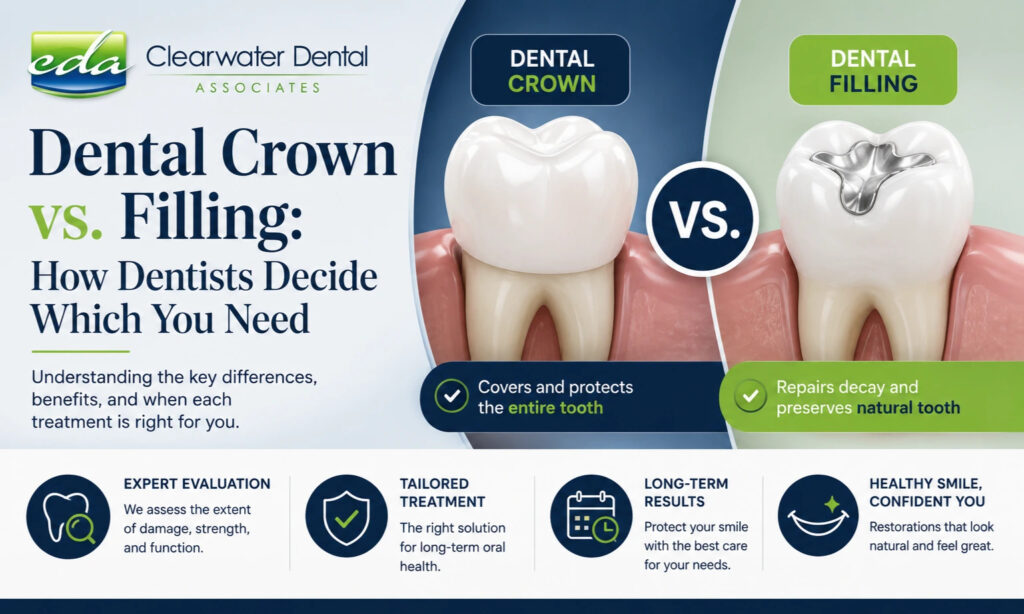
If a dentist tells you a tooth needs work, your next question is almost always the same: a filling or a crown? They’re both common restorations, both fix damaged teeth, and both protect what’s left but they do very different things, and choosing between them isn’t a matter of preference.
A dental filling repairs a specific damaged portion of the tooth. The dentist removes the decayed material, and the filling material replaces only what was taken out. A dental crown, on the other hand, covers the entire tooth above the gum line protecting it from the outside when the inside can no longer hold things together on its own.
Which one is appropriate depends on how much healthy tooth remains, where the damage is, and what the tooth needs to function reliably over time. This guide explains how dental crowns and fillings differ, when each is typically used, and how a dentist thinks through that decision.
What Is a Dental Filling?
A filling is a direct restoration — meaning it’s placed directly into the tooth in a single appointment. When tooth decay creates a cavity, the dentist removes the decayed portion of the tooth and fills the space left behind with a restorative material.
The goal is to restore the tooth’s shape and function while stopping the decay from spreading further. Because the filling only replaces what was removed, it works best when there’s enough remaining tooth structure around it to provide support.
Today, composite resin a tooth-colored material that bonds to the remaining enamel and dentin — is the most commonly placed filling material. It’s used for small cavities and moderate-sized restorations on both front and back teeth. Silver amalgam, a durable alloy that has been used in dentistry for generations, remains an option in some clinical situations, though composite is now the dominant choice in most practices.
The type of material that works best for your tooth depends on several factors. Our blog on dental filling materials explains the differences in more detail.
Most fillings are completed in one dental visit. The dentist numbs the tooth, clears out the decay, shapes the space, places the filling material, and adjusts the bite. The whole process usually takes less than an hour.
What Is a Dental Crown?
A dental crown is a full-coverage restoration that caps the entire tooth above the gum line. Instead of filling a cavity from the inside, the crown wraps around the outside — restoring the tooth’s shape, size, and strength by encasing what’s left beneath it.
Crowns are used when a tooth is too damaged, cracked, or weakened for a filling to reliably hold. They’re also placed after root canal treatment to protect the tooth from fracture, to restore a broken tooth, to anchor a dental bridge, or to cover a dental implant.
Crown materials vary depending on the tooth’s location and the patient’s needs. Common options include:
- Porcelain or ceramic — highly aesthetic, matched to the surrounding natural teeth, often preferred for front teeth
- Zirconia — extremely durable and increasingly popular for back teeth where strength is the priority
- Porcelain-fused-to-metal — combines a metal core with a porcelain exterior; a long-standing option that provides both strength and appearance
- Gold — durable, gentle on opposing teeth, and well-tolerated by gum tissue; less requested today but still appropriate in specific situations
The crown procedure typically takes two visits in a traditional workflow. At the first appointment, the dentist prepares the tooth by removing a layer of enamel from all sides — creating room for the crown to fit without adding bulk to the bite. An impression or digital scan is taken, a temporary crown is placed, and the permanent crown is fabricated off-site. At the second visit, the temporary is removed, the permanent crown is fitted and adjusted, and it’s cemented into position.
Some practices use CAD/CAM technology to design and mill ceramic crowns chairside, which can allow the process to be completed in a single appointment. Whether this approach is available and appropriate depends on the tooth and the practice’s equipment.
Crown vs. Filling at a Glance
| Feature | Dental Filling | Dental Crown |
|---|---|---|
| What it does | Repairs the damaged portion of the tooth by filling the cavity | Covers the entire tooth above the gum line to restore shape, strength, and function |
| Tooth coverage | Partial — only the space left by decay removal | Full — caps the entire visible tooth |
| Best suited for | Small to moderate cavities with sufficient remaining tooth structure | Severely damaged, cracked, weakened, or heavily restored teeth |
| Material options | Composite resin (tooth-colored), amalgam | Ceramic, porcelain-fused-to-metal, zirconia, gold |
| Appointments | Typically one visit | Typically two visits; some practices use same-day CAD/CAM |
| Tooth removal | Only decayed material removed | More healthy tooth structure reduced to create space for the crown |
| After root canal | Filling seals the access opening; usually still needs a crown | Crown placed after root canal to protect the tooth long-term |
| Longevity factors | Cavity size, tooth location, oral hygiene, bite forces | Material, fit, oral hygiene, bite, and whether the tooth had prior root canal treatment |
| Cost considerations | Generally lower cost; varies by size and material | Generally higher cost due to more material, lab work, and preparation involved |
How Does a Dentist Decide Between a Crown or Filling?
The most important factor is how much healthy tooth structure remains after the damaged material is removed. This is what the dentist is evaluating when they examine the tooth and review your X-rays — not just how large the cavity looks from the outside.
Here’s how that decision typically works:
A Filling Is Usually Appropriate When:
- The cavity is small to moderate in size
- The tooth walls surrounding the cavity are structurally sound
- None of the cusps — the raised points on the chewing surface — are cracked or at serious risk of fracturing
- Enough natural tooth structure remains to support and anchor the filling material
- The tooth hasn’t had multiple previous restorations that have weakened it over time
A Crown Is Usually Considered When:
- The cavity or existing large filling takes up a significant portion of the tooth
- One or more cusps are cracked, fractured, or at high risk of fracturing under bite pressure
- The tooth is significantly weakened — either from decay, a crack, or a prior root canal treatment
- A root canal has been performed, and the tooth needs full protection to prevent fracture
- The remaining tooth structure is insufficient to reliably hold a filling without risk of the tooth splitting
- A filling alone would leave the tooth vulnerable to further damage, or even tooth loss
There’s no universal size threshold that turns a filling situation into a crown situation. What matters is the clinical picture, how much tooth is left, where the damage is, and what the tooth needs to function safely. A large filling that covers most of the chewing surface can technically be placed, but if it weakens the tooth further or leaves a cusp unsupported, a crown may provide better long-term protection.
A dentist may also recommend a crown when a tooth has had a large filling for years and that filling is now failing. In that case, there may not be enough natural tooth structure remaining to support a new filling, and a crown becomes the more predictable option.
What About Root Canal Treatment — Filling or Crown?
After a root canal, the tooth is structurally different. The procedure removes the pulp from inside the tooth, which leaves it more brittle and susceptible to fracture. especially in back teeth that absorb significant chewing forces.
In most cases, a filling is used immediately after root canal treatment to seal the access opening, but a dental crown is still recommended to protect the tooth long-term. Without a crown, a tooth that’s had a root canal is at real risk of cracking — which can lead to tooth loss. Your dentist will discuss timing based on which tooth is involved and what your overall tooth decay treatment plan looks like.
Is a Crown Always Better Than a Filling?
No. A crown involves removing more of the natural tooth structure to create room for the cap — that’s structure that can’t be restored if the crown eventually needs replacement. When a filling is clinically appropriate, it’s the more conservative option, and conservative dentistry is generally the right approach.
The question isn’t which restoration is superior in the abstract. It’s which one is appropriate for the specific condition of this specific tooth. A filling that’s placed when a crown was indicated will likely fail and may result in a cracked tooth that’s harder to save. A crown placed when a filling would have sufficed removes healthy enamel unnecessarily.
Neither outcome serves the tooth well. The goal is an accurate assessment and the right match between the tooth’s condition and the restoration chosen.
Longevity and Cost Considerations
Both restorations can last for many years with proper care, but longevity depends on more than the type of restoration — it depends on the tooth’s location, bite forces, oral hygiene habits, and how well-supported the restoration is by the surrounding tooth structure.
Fillings placed in small cavities with adequate surrounding structure tend to hold up reliably. Larger fillings in heavily loaded back teeth face more stress and may wear or crack over time. Crowns, when well-fitted and properly maintained, can protect a tooth for a long time — but they require more investment upfront, both in terms of cost and the irreversible preparation of the tooth.
Cost varies based on the tooth, material, extent of work, and your dental insurance coverage. Fillings are generally less expensive than crowns because they require less material and preparation. Crowns involve more steps, including laboratory fabrication in most cases, which is reflected in the cost.
For a specific estimate, it’s best to contact the office directly after an examination. There’s no way to give accurate pricing without knowing what the tooth actually needs.
Frequently Asked Questions
What is the main difference between a dental crown and a filling?
A filling repairs the damaged portion of a tooth by replacing material lost to decay. A dental crown covers the entire tooth above the gum line, protecting it when the remaining structure is too weak or damaged to support a filling alone. The key distinction is coverage: partial for a filling, complete for a crown.
How do I know if I need a crown or a filling?
You won’t be able to tell on your own — and neither can a dentist without examining the tooth and reviewing X-rays. The decision comes down to how much healthy tooth structure remains after decay or damage is removed, and whether that remaining structure can reliably hold a filling. If there’s enough tooth left, a filling may work. If the tooth is cracked, significantly weakened, or has had a large portion replaced by previous restorations, a crown is often the better option.
Can a large filling eventually need to become a crown?
Yes, and this is common. Every time a filling is replaced, some additional tooth structure is removed to prepare the space. Over time, a tooth that’s had multiple fillings may reach a point where there isn’t enough natural structure left to support another filling. At that point, a crown provides better long-term protection. Your dentist will monitor this over time at regular check-ups.
Does a tooth always need a crown after a root canal?
In most cases, yes — especially for back teeth. Root canal treatment removes the pulp from inside the tooth, which makes it more brittle and more susceptible to fracture under normal chewing forces. A dental crown placed after a root canal protects the tooth and significantly reduces the risk of it cracking. Front teeth sometimes get away with just a filling, but this depends on the tooth and the amount of remaining structure.
Is a crown more expensive than a filling?
Generally, yes. Crowns involve more steps — including tooth preparation, impressions or digital scanning, laboratory fabrication, and a return appointment — and more material. Fillings are typically completed chairside in one visit with less material involved, making them less expensive in most cases. The difference in cost varies by tooth, material, and insurance coverage. For specific pricing at Clearwater Dental Associates, the best step is to call the office or book an examination.
Can I get a filling instead of a crown to save money?
It depends entirely on what the tooth needs. If a filling is clinically appropriate, it’s a perfectly good option — and the more conservative one. If a filling isn’t adequate for the condition of the tooth, placing one anyway may result in the filling failing, the tooth cracking, and ultimately a more expensive or complicated situation. When a dentist recommends a crown, it’s based on what they find during the clinical exam, not a preference for one restoration over another.
Not Sure If Your Tooth Needs a Crown or a Filling?
The only way to know for certain is a clinical examination. X-rays show how deep the decay goes and how much tooth structure remains — and that’s the information that drives the decision. No amount of research replaces that evaluation.
At Clearwater Dental Associates, we take a conservative approach to restorative dentistry — preserving as much natural tooth as possible while recommending the restoration that’s right for the specific situation. We explain the options clearly before any treatment begins so you understand exactly what’s needed and why.
If you’re in Clearwater or the surrounding Pinellas County area and have a tooth that’s been bothering you, call us at (727) 797-8800 or use our online booking link to schedule an evaluation. And if you’d like to understand more about your filling options first, our overview of tooth-colored composite fillings covers what to expect from that process.