

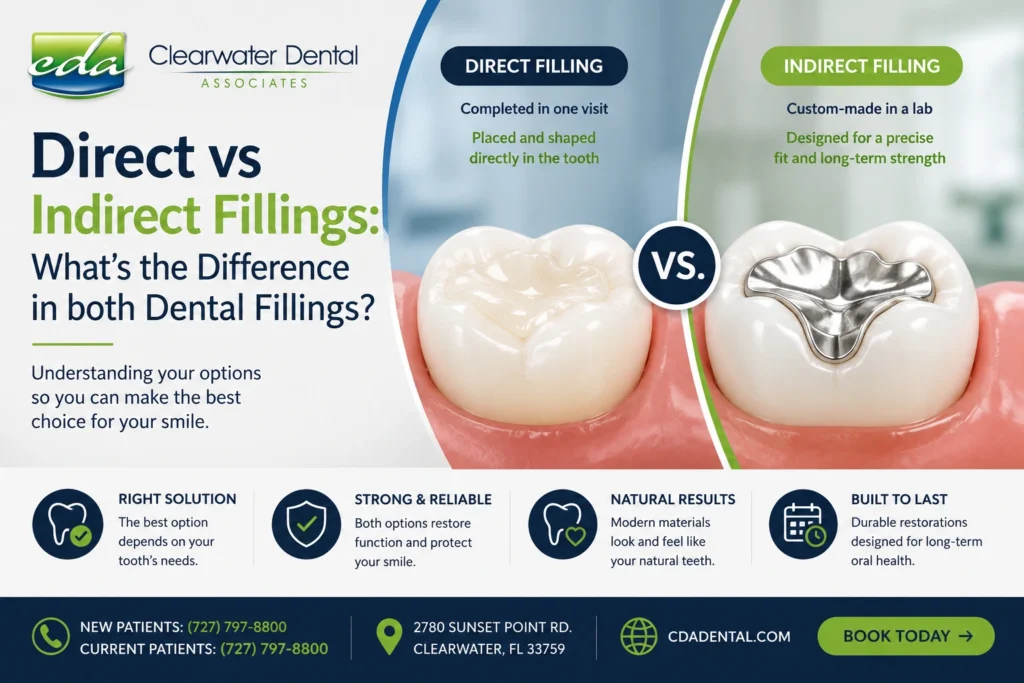
When a dentist tells you a tooth needs a filling, they’re usually talking about one of two approaches: a direct filling or an indirect filling. The terms sound simple enough, but they actually describe a fundamental difference in how a restoration is made and placed and that difference affects everything from how many appointments you need to how much healthy tooth remains when the work is done.
A direct filling is placed and shaped inside the prepared tooth, chairside, during a single dental visit. Composite resin — the tooth-colored material most patients are familiar with today — is the most common direct filling material.
An indirect filling is different type of filling. The tooth is prepared, but the restoration itself is fabricated outside the mouth — either in a dental lab or using digital design and milling technology — and then bonded or cemented to the tooth. Dental inlays and onlays are the most common examples of indirect restorations.
Neither type is automatically better. The appropriate choice depends on how much tooth structure remains, where the cavity is located, how large the damaged area is, and the dentist’s clinical assessment. This guide explains each approach, the materials involved, and how a dentist thinks through the decision.
What Is a Direct Filling?
A direct filling is placed directly into the prepared cavity without ever leaving the mouth for fabrication. Once the dentist removes the decayed material and prepares the tooth, filling material is placed into the space, shaped to restore the tooth’s natural contours, and hardened — usually with a curing light.
The most widely used direct filling material today is composite resin. These tooth-colored composite fillings are made from a mixture of glass or quartz particles suspended in a resin matrix. They bond chemically and mechanically to the remaining tooth structure, which means the dentist typically needs to remove less healthy enamel than with older approaches.
Silver amalgam — a durable alloy of metals that includes mercury in a stable, bonded form — was the standard direct filling material for much of the 20th century. It remains effective in certain clinical situations, though many patients and practices now prefer tooth-colored alternatives. The American Dental Association recognizes both composite and amalgam as safe, evidence-based options for direct restorations.
Because the entire process happens chairside, most direct fillings are completed in a single appointment. This makes them a practical choice for many cavities — particularly those that are small to moderate in size, where enough healthy tooth structure remains to support the filling.
What Is an Indirect Filling?
An indirect filling is fabricated outside the prepared tooth and then fitted and bonded into place. Instead of shaping material chairside, the dentist prepares the tooth, takes a precise impression or digital scan, and sends that information to a dental lab — or processes it through in-office CAD/CAM software — so a custom restoration can be designed and made from durable materials like ceramic, porcelain, or in some cases gold.
The most common types of dental filling are indirect restorations are inlays and onlays. These fit within or over the chewing surface of a back tooth and are cemented into position once the final restoration is ready.
In a traditional workflow, this process involves two appointments. At the first visit, the tooth is prepared and a temporary filling is placed to protect it while the lab fabricates the custom restoration. At the second visit, the temporary is removed, the fit is confirmed, and the permanent inlay or onlay is bonded into place.
It’s worth noting that digital dentistry has changed this in some settings. Practices equipped with chairside CAD/CAM technology can sometimes design and mill a ceramic restoration in a single visit, though this depends on the tooth, the restoration type, and the clinical situation. The distinction between “one visit” and “two visits” is no longer a reliable rule for all indirect restorations.
“Indirect restoration” is the more precise clinical term you may hear a dentist use — because the fabrication happens away from the mouth without the need for the patient to be present.
Direct vs. Indirect Fillings at a Glance
| Feature | Direct Filling | Indirect Filling / Restoration |
| Where it is made | Inside the mouth, directly in the prepared cavity | Outside the mouth, in a dental lab or using CAD/CAM technology |
| How it is placed | Shaped and hardened chairside in a single procedure | Bonded or cemented to the prepared tooth at a separate step |
| Common examples | Composite resin filling, tooth-colored filling | Dental inlay, dental onlay, ceramic restoration |
| Common materials | Composite resin, tooth-colored composite (and historically, amalgam) | Ceramic, porcelain, composite, gold |
| Appointment considerations | Typically completed in one dental visit | Traditional workflow may involve two appointments; digital workflows can sometimes reduce this |
| Typical use | Small to moderate cavities with adequate remaining tooth structure | Larger cavities, weakened cusps, or situations needing greater structural support |
| Tooth structure considerations | Works best when enough healthy enamel and dentin remain to support the restoration | May be preferred when a cavity or fracture has compromised significant structure, particularly a cusp |
| Cost considerations | Generally lower cost due to chairside fabrication | Generally higher due to materials and fabrication; varies widely by type and case |
What Materials Are Used?
Understanding different types of dental fillings direct and indirect fillings also means understanding a key distinction: the method and the material are separate considerations.
“Direct” and “indirect” describe how and where a restoration is made — not what it’s made of. Composite resin, for example, is typically used in direct fillings, but it can also be fabricated as an indirect restoration in a lab setting. Ceramic and porcelain, on the other hand, are almost always used for indirect restorations because they require precise milling or layering outside the mouth.
Common Direct Filling Materials
- Composite resin — the standard tooth-colored filling material used in most practices today
- Silver amalgam — a time-tested option, less common now but still clinically appropriate in certain cases
Common Indirect Restoration Materials
- Ceramic and porcelain — excellent aesthetics, high durability, excellent stain resistance
- Gold — long-lasting and well-tolerated by the gum tissue, though less commonly requested today due to aesthetics
- Lab-fabricated composite — a middle ground that offers aesthetics similar to direct composite but with the precision fit of an indirect restoration
Each material has trade-offs in terms of strength, appearance, cost, and technique sensitivity. Your dentist will factor all of these into the recommendation.
When Might a Dentist Recommend a Direct Filling?
A direct filling is often the first-line choice when a cavity is small to moderate in size and enough healthy tooth structure remains to support the restoration. Here are some of the factors a dentist considers:
- The cavity is limited in size and doesn’t extend into a cusp or significantly weaken the surrounding walls
- Adequate enamel and dentin remain to anchor a direct material without risk of fracture
- The tooth is in a location where composite can be properly isolated and bonded
- The patient’s bite and chewing forces don’t place unusual stress on that tooth
- Speed and simplicity are priorities, and a chairside restoration is clinically appropriate
Choosing between direct and indirect fillings isn’t simply about cavity size. If you’re concerned about a tooth, a clinical examination and tooth decay treatment evaluation are the right starting point.
When Might an Indirect Restoration Be Recommended?
There are situations where a conventional direct filling may not provide enough structural support for the tooth long-term. An indirect restoration may be worth considering when:
- The cavity or damaged area is extensive, affecting a large portion of the tooth’s chewing surface
- One or more cusps of the tooth are weakened or have fractured — a situation where a directly placed filling could crack the remaining structure
- Significant tooth structure has been lost, making a custom-fitted restoration a more stable solution
- An inlay or onlay can restore the tooth while preserving more natural structure than a full crown would require
- Aesthetics and longevity are high priorities, and ceramic materials are preferred
It’s also important to understand that a large cavity doesn’t automatically call for an indirect filling. Sometimes the damage is extensive enough that a full dental crown — which covers the entire visible surface of the tooth — provides better protection. In other cases, additional treatment such as a root canal may be needed before any restoration is placed. The right answer depends on what the clinical examination reveals, not a universal size threshold.
Inlays and Onlays: How Do They Fit In?
Inlays and onlays occupy an important space between a conventional filling and a full dental crown.
An inlay fits within the cusps of a tooth — essentially filling the central portion of the chewing surface without covering the cusp tips. An onlay extends further, covering one or more cusps along with the central area. Some dentists informally call onlays “partial crowns” because of the additional coverage, though they still preserve significantly more natural tooth structure than a full crown.
Both are indirect restorations. Both are custom-fabricated, precision-fitted, and cemented into position. And both are worth asking about if you’ve been told a tooth needs significant work but a full crown hasn’t yet been discussed.
Are Indirect Fillings Better Than Direct Fillings?
Not necessarily. An indirect restoration made from ceramic tends to be highly durable and resistant to wear and staining — but that doesn’t mean it’s the right choice for every tooth. A well-placed composite resin filling in the right situation can last many years and serve the tooth perfectly well.
The goal of any restoration is to return the tooth to function, protect the remaining structure, and be sustainable long-term. A direct filling achieves that goal for the right type of cavity just as effectively as an indirect restoration achieves it for a more complex one.
The quality of the restoration matters as much as the type. Proper isolation, accurate material placement, and a good bite adjustment are factors that affect how any filling performs over time.
How Does a Dentist Choose Between Direct and Indirect?
The decision involves a structured clinical evaluation, not a simple rule. Here’s what typically goes into the assessment:
- Size and extent of the cavity or damaged area
- Amount of healthy tooth structure remaining, particularly the walls and cusps
- Whether a cusp has fractured or is at risk of fracturing under normal bite forces
- Location of the tooth — back teeth bear more chewing load than front teeth
- Previous restorations on the same tooth and how they’ve held up
- Material requirements based on aesthetics, strength, and patient preferences
- Whether additional treatment is needed before a restoration can be placed
- Cost, insurance coverage, and the patient’s overall treatment priorities
A full-mouth X-ray and hands-on clinical examination are usually needed before any recommendation is made. No article — including this one — can substitute for that evaluation.
How Long Do Direct and Indirect Fillings Last?
Longevity varies considerably depending on the material, the size of the restoration, where the tooth is in the mouth, and how the patient cares for it. Composite resin fillings in low-stress areas can last a decade or more with proper oral hygiene and regular dental check-ups. Ceramic inlays and onlays tend to be highly durable over the long term when they’re well-fitted and cared for.
Factors that affect how long any restoration lasts include bite forces, grinding or clenching habits, diet, the condition of the surrounding tooth structure at the time of placement, and how consistently the patient attends follow-up appointments. No restoration is permanent, and all of them benefit from consistent preventive dental care.
Keeping up with preventive dental care — including exams and cleanings — is one of the most reliable ways to extend the life of any filling or restoration.
How Much Do Direct and Indirect Fillings Cost?
Direct fillings are generally less expensive than indirect restorations. Because the material is placed and shaped chairside without laboratory involvement, the cost of fabrication is lower. Composite resin fillings vary in cost depending on the size of the cavity, the tooth involved, and the practice.
Indirect restorations — inlays, onlays, and crowns — typically involve additional cost because they require either a dental lab or digital fabrication, more precise tooth preparation, and often a second appointment. The materials used (ceramic, porcelain, gold) also affect the final cost, as does the complexity of the case.
Insurance coverage varies by plan. Most dental insurance plans cover a portion of basic fillings, and many cover indirect restorations when they’re clinically justified. For an accurate estimate specific to your situation, contact the office directly — pricing can’t be accurately generalized across cases.
Frequently Asked Questions
What is the difference between a direct and indirect filling?
A direct filling is placed and shaped inside the tooth during a single appointment. An indirect filling — such as a dental inlay or onlay — is fabricated outside the mouth and then cemented or bonded into the prepared tooth. The difference lies in how and where the restoration is made, not necessarily what material it contains.
Is a composite filling direct or indirect?
Composite fillings placed chairside in a single visit are direct restorations — the most common type. Composite can also be used as an indirect material when fabricated in a dental lab, but the vast majority of composite fillings patients receive are direct.
Are inlays and onlays indirect fillings?
Yes. Both inlays and onlays are indirect restorations. They are custom-made outside the mouth and bonded or cemented to the tooth. An inlay fits within the cusps of the tooth; an onlay extends over one or more cusps.
Do indirect fillings always require two visits?
Traditional indirect restorations involve two appointments — one to prepare the tooth and take an impression, and a second to place the final restoration after it has been fabricated. However, some dental practices use chairside CAD/CAM technology that can design and mill certain restorations in a single visit. This capability depends on the equipment available and the type of restoration needed.
Is an indirect filling stronger than a direct filling?
Not as a universal rule. Ceramic and porcelain indirect restorations are generally highly durable and resistant to staining, and they can provide excellent support for teeth with larger areas of damage. Direct composite resin fillings, when well-placed and appropriately sized, also perform reliably. The key factor is matching the right restoration to the right clinical situation.
When is a cavity too large for a regular filling?
There’s no single size threshold. What matters more than the size of the cavity is how much healthy tooth structure remains after decay removal. If the cavity has weakened the cusps or compromised the walls of the tooth, an indirect restoration or crown may provide better long-term support. A dentist prepares the tooth, evaluates the remaining structure, and then makes the recommendation based on what’s there.
Is a dental crown an indirect restoration?
Yes. A full crown is an indirect restoration that covers the entire visible portion of the tooth. It requires lab fabrication and cementation at a separate appointment — the same indirect process as an inlay or onlay, just with full-coverage rather than partial coverage. Crowns are typically recommended when a tooth has insufficient structure to support an inlay or onlay, or when maximum protection is needed.
Not Sure Which Type of Restoration You Need?
The right answer depends on the specific condition of your tooth — how much healthy structure remains, where the cavity is located, and what treatment will protect the tooth reliably over time. That can only be determined through a clinical examination and X-rays, not through an article.
At Clearwater Dental Associates, our team evaluates each tooth individually and explains your restorative dentistry options clearly before any treatment begins. We serve patients in Clearwater and the surrounding Pinellas County communities. If you have a cavity, a broken filling, or a tooth that’s been bothering you, we’re happy to take a look.
Call us at (727) 797-8800 or use the online booking link to schedule an evaluation.